Why AI Made Your PM Team Faster But Not Better
AI made your PM team faster at the part of their job that was never the hard part. After coaching 500+ PMs, the pattern is clear: delivery got faster, strategy stayed stuck. Here's why and what to do about it.
I've coached 500+ product managers over the last three years. AI has changed how fast they work. It hasn't changed what they work on.
The PMs who couldn't walk into a room with their CFO and explain why their product deserves more investment still can't. They just have better-formatted PRDs and faster mockups.
This pattern shows up everywhere. First-year associates, senior PMs, VPs running 40-person product orgs. Delivery got faster. Strategy stayed stuck.
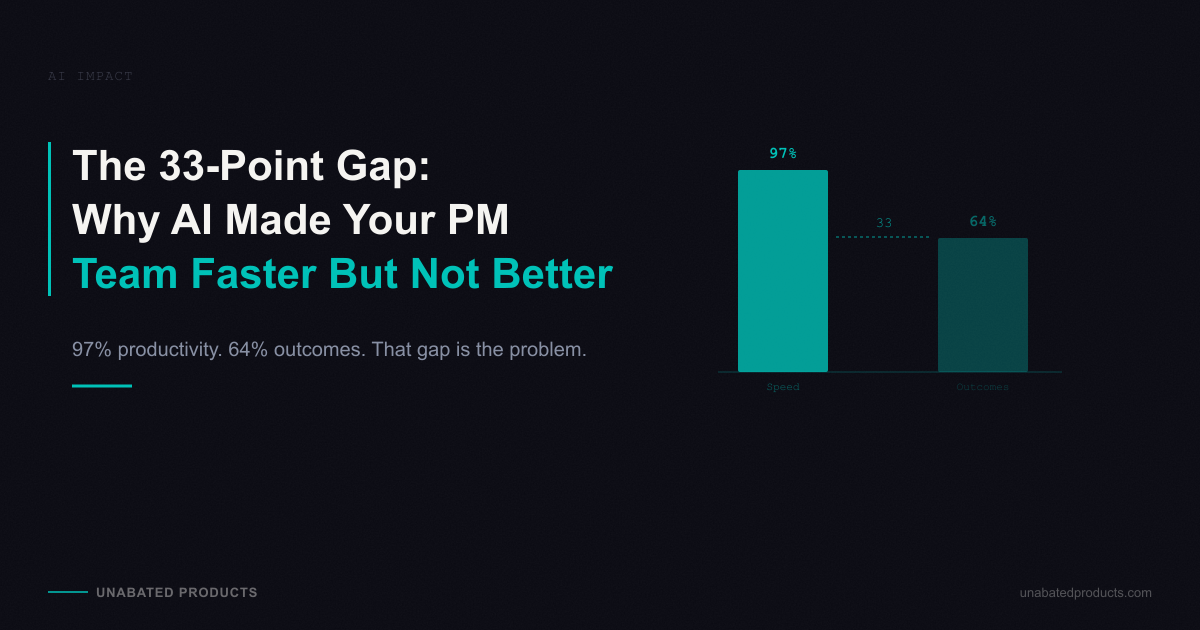
A global survey confirmed it at scale: 97% of PMs say AI improved their personal productivity, but only 64% say it improved their product outcomes. That gap between doing things faster and doing the right things is what I see in every coaching session.
Where the AI hours actually go
Ant Murphy's 2026 analysis of how PMs spend their AI time makes the gap obvious.
21.5% goes to writing PRDs. 19.8% goes to building mockups. Data analysis, customer call summaries, competitive research. All delivery tasks. All approaching zero marginal cost.
Roadmap strategy? 1.1%.
User research? 4.7%.
That distribution is not random. PMs use AI for the work their company already knows how to measure. Sprint velocity. Feature completion. Spec quality. Those metrics are visible, trackable, and rewarded.
The strategic work, the work that actually moves product outcomes, is invisible to most performance systems. Nobody gets a bonus for "connected the roadmap to the P&L." Nobody gets promoted for "killed a feature the VP requested because the unit economics didn't work." So that work doesn't get AI-augmented. It doesn't get done at all.
AI didn't create this pattern. It accelerated it.
The amplifier problem
AI is an amplifier. It makes whatever you already are more efficient.
If a PM thinks in features, AI helps them write better specs. Faster wireframes. Cleaner user stories. The delivery muscle gets stronger.
If a PM thinks in business outcomes, AI helps them find the right problems faster. Better data synthesis. Sharper competitive positioning. Tighter connections between customer behavior and revenue impact.
Same tool. Different input. Completely different output.
The PMs I work with are getting faster at exactly this. A PRD that used to eat an afternoon now takes a fraction of one. They are right to be proud of that. It's real efficiency.
The question I ask next is the one that lands badly: when did you last build a business case for your leadership team? Often the answer is never. Never built one, never been asked to. The company measures sprint velocity and feature completion, and AI makes those numbers look great.
The product still isn't moving the needle on retention. Because the features shipping faster are the wrong features. AI made that mistake cheaper to execute, not easier to catch.
That's the amplifier problem at scale. Faster delivery doesn't fix bad strategy. It amplifies it.
Why 57% of PMs were never trained for this
The training gap explains why the amplifier problem is so widespread.
Productside (formerly 280 Group) found that 57.2% of product managers have never received formal training on strategy, business acumen, or stakeholder influence. They learned PM by doing PM. Which means they learned whatever version of PM their first company practiced.
For most companies, that version is delivery. Write specs. Groom the backlog. Run sprint ceremonies. Keep engineering fed. Keep stakeholders informed. Ship on time.
That is project management with a product manager title. And it's the version of PM that AI makes almost free.
In January 2026 I went through PM job postings and the responsibilities read like a delivery job. Toptal's Senior Product Manager listing asked the hire to "own and lead all aspects of an established agile team including backlog grooming prioritization." 360Learning's Product Manager listing asked for someone to "manage the roadmap and product backlog of your squad" and to "ensure timely and effective delivery." CallRail's asked for someone to "manage the daily workflow with a sprint team." Backlog grooming. Sprint management. Spec writing. Coordination between engineering and design. The strategic work, deciding what to build and why, was not in the job description. It was assumed to live somewhere above.
So when companies roll out AI tools to their PM teams, the PMs do exactly what they've always done. Delivery. Just faster. And the 33-point gap widens because speed without direction is just organized waste.
The corporate buyer's dilemma
If you're a VP of Product or Head of L&D reading this, you've probably already felt this pattern without having a name for it.
You invested in AI tooling. Your PMs adopted it (probably faster than any other department). The productivity dashboards genuinely improved. Spec turnaround time dropped. Sprint velocity climbed. Stakeholder satisfaction with "responsiveness" went up.
And then your board asked about revenue impact. Customer retention. Market share in the new segment you launched into. The numbers that actually drive the business.
Those didn't move. Or they moved less than you expected.
I keep hearing this from VPs of Product. The pattern is structural. Research shows that only 8% of PM teams have all five organizational foundations in place. That means 92% of product orgs are set up for delivery, not outcomes. AI tooling didn't fix the structure. It optimized within it.
BCG's research on digital transformations reinforces this. 70% fail. The common thread across those failures is talent and capability, not technology. The tools work. The people using them weren't equipped to use them strategically.
HBR published a piece in February 2026 with the headline: "To drive AI adoption, build PM skills." The argument matches what coaching reveals. AI value depends on the capability of the person using it. The tools are fine.
What actually closes the gap
The gap doesn't close with more AI tools. And it doesn't close with framework certifications or asynchronous courses where PMs watch videos and check boxes.
It closes with behavior change.
The skill that sits in the gap is business acumen. It's the ability to take what a PM already knows about users and products and translate it into the language that executives, finance teams, and board members use to make decisions. Revenue. Margin. Acquisition cost. Payback period. Contribution profit.
Most PMs speak user language: adoption, engagement, NPS, feature usage. Executives speak business language. These describe the same reality. But most PMs never learn to translate between them. And no AI tool does that translation for you, because the translation requires judgment about what matters to your specific business, not generic summaries.
That translation ability changes what PMs do with AI. Instead of using Claude to write better specs, they use it to analyze customer behavior patterns, model pricing scenarios, or stress-test a go-to-market hypothesis. Strategic thinking is the shift from anchoring on features ("what should we build next?") to anchoring on outcomes ("what does our customer need to succeed, and how does that connect to our business model?"). The tool stays the same. The questions change. And that's where the outcomes change.
Financial fluency compounds the effect. PMs who can read a 10-K, connect a feature to a P&L line item, or calculate the unit economics of a new pricing model don't just make better decisions. They make decisions that executives understand and fund. That's the difference between "I think we should build this" and "this feature reduces churn by 3 points, which adds $2.4M ARR over 12 months."
Upskilling beats replacing
Pluralsight's 2025 study found that 89% of organizations say upskilling existing employees is more cost-effective than hiring new ones. That tracks with what I see in corporate coaching engagements. The PMs are already there. They already know the product, the customers, the internal politics, the technical constraints. What they're missing is the strategic layer on top.
Replacing them with "AI-native PMs" doesn't fix the gap. It just resets the clock with someone who knows the tools but not the business. The fastest path to closing the delivery-strategy gap is building the capability that AI can then amplify in the right direction.
That means coaching that changes behavior, not courses that transfer knowledge. It means practice with real stakeholders, real business cases, real P&L conversations. Not simulations. Not case studies from companies your PMs will never work at.
The PMs who close the gap are the ones who use AI to handle the delivery work (specs, analysis, mockups) so they can spend more time on strategy, influence, and business impact. That shift doesn't happen by installing another tool. It happens by building the muscle that makes the tool useful for the right work.
What this means for your team
If you're a product leader, run this quick test. Ask three PMs on your team: "What's the revenue impact of the last feature you shipped?"
If they can answer in specific numbers, connected to business metrics your CFO would recognize, you're in the 64% where AI is actually improving outcomes. Keep going.
If they answer with adoption percentages, engagement metrics, or "we're still measuring," you've found the gap. Your team is using AI to be more productive at work that isn't moving your business forward.
You don't fix this by pulling AI out. You fix it by building the capability that tells AI where to point.
The hidden system is straightforward: companies train PMs on delivery and evaluate them on strategy. AI made that mismatch louder. Closing it is where the real work is.
The Influential PM is a 3-week live cohort for B2B PMs who want to operate at the strategic level. Get the career results that follow.
Former VP of Product at a Big 4 firm. Has coached 500+ PMs across Fortune 500 companies. Teaches the Influential PM cohort on Maven.