Product Manager Business Acumen: What It Is and How to Build It
Business acumen is what separates senior PMs from everyone else: the ability to translate product work into revenue, cost, and growth language. Here's what it looks like in practice and how to build it.
You've been trying to be more strategic.
Your manager says "think bigger." Your skip-level says "connect your work to business outcomes." Promotion feedback tells you to "demonstrate more senior-level thinking."
So you read about OKRs. You learn RICE scoring. You study Jobs to Be Done. You watch videos on product strategy.
Nothing changes. You still feel like a project manager wearing a product manager's title.
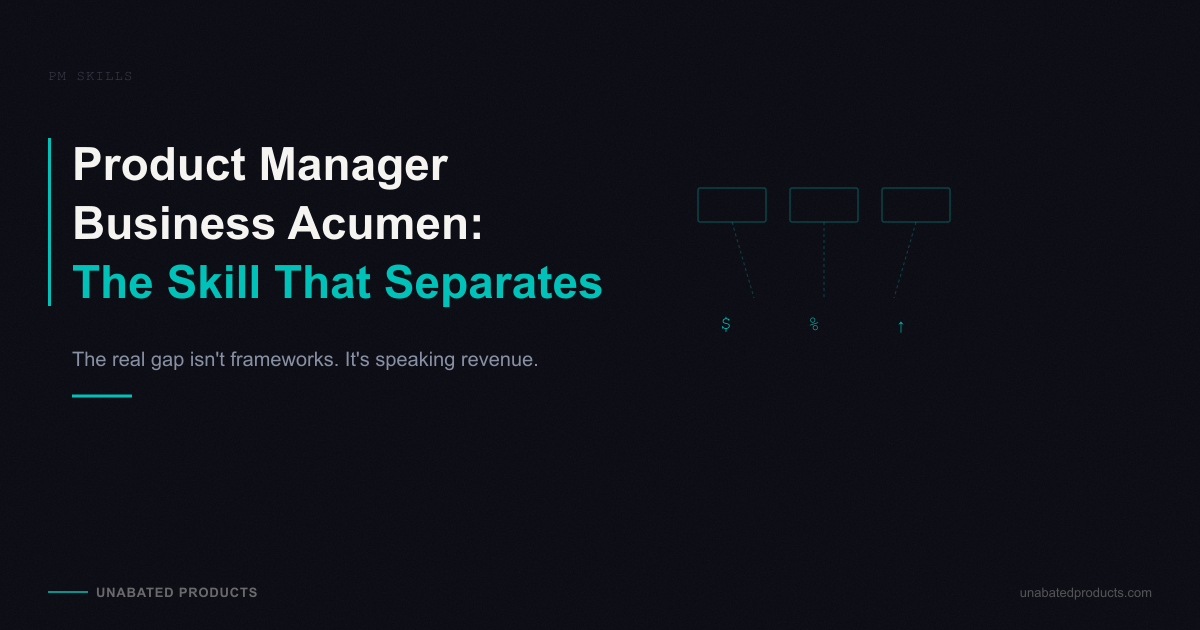
Here is why. The gap is not strategy frameworks. The gap is business acumen. And the reason nobody tells you that is because they don't know how to explain what business acumen actually means for a product manager.
What business acumen is not
It is not an MBA. It is not knowing how to read a balance sheet. It is not memorizing financial jargon.
Business acumen for product managers is a translation skill. It is the ability to take what you already know about users and products and express it in the language that executives, finance teams, and board members actually use to make decisions.
Think of it like moving to a country where you understand everything happening around you but you can't make yourself understood. You see the problems. You know the solutions. But when you try to explain them, people stare at you like you're speaking a different language.
You are.
Most PMs speak user language: adoption, engagement, NPS, feature usage, customer feedback. Executives speak business language: revenue, margin, acquisition cost, payback period, contribution profit. These are two descriptions of the same reality. But most PMs never learn to translate between them.
The elevator test
Your CEO catches you in the elevator. "How's the product going?" You have 30 seconds.
Answer A: "We shipped three features this sprint and we're on track for Q2."
This is a project update. It tells the CEO what your team did. It tells them nothing about whether any of it mattered.
Answer B: "Customer adoption hit 45%. We're testing whether engagement follows."
Better. You're thinking about outcomes, not outputs. But adoption and engagement are user metrics. The CEO is thinking about revenue. You're still translating from the wrong dictionary.
Answer C: "The pricing experiment added $240K ARR. Next bet: reducing churn in the mid-market segment."
This is business acumen. Same product. Same work. But framed in the language the CEO uses to run the company.
Most PMs give Answer A. They think it's good because it's accurate. It is accurate. It is also invisible. An accurate project update gets a nod. A business impact statement gets a follow-up meeting.
Why this gap exists
I've coached over 500 PMs. In 11 out of 12 first coaching sessions, the PM opens with some version of "I'm trying to..." Trying to get promoted. Trying to get buy-in. Trying to be more strategic.
They describe the symptoms. They never diagnose the cause.
When I ask a PM who's been passed over for promotion to walk me through their last big win, they say: "We redesigned the onboarding flow and reduced drop-off by 40%."
That's a good result. But watch what happens when I push: How much revenue was at stake in that drop-off? What was the cost of acquiring those users who were dropping off? If you recovered 40% of that drop-off, what's the dollar value? How does that compare to other investment options the company had?
Blank stare. These are smart people. Nobody taught them to think about their work this way.
PM training focuses on the demand side. Discovery, prioritization, stakeholder management, roadmap planning. All important. All insufficient. None of it teaches you to translate user value into business value. And that translation is exactly what "senior-level thinking" means.
Three gaps hiding inside one problem
Business acumen shows up as three distinct gaps. Most PMs have all three.
Gap 1: The language gap
You describe your product's impact using user metrics. Your executives think in P&L terms.
"We increased retention by 15%" means nothing to a CFO. "We recovered $1.2M in annual revenue that was walking out the door" means everything. Same data point. Different language.
The fix is not learning finance vocabulary. It's building a translation habit. Every time you report a product metric, add the second sentence: the business impact. Retention went up. AND that means revenue went up by X. Feature adoption increased. AND that reduced support costs by Y. Churn dropped. AND that improved lifetime value by Z.
Gap 2: The metrics gap
You track what your product does. You don't track what your product is worth.
Daily active users. Feature adoption. Task completion rate. Support ticket volume. These are activity metrics. They tell you the product is being used. They don't tell you the product is generating value.
The metrics that matter to the business: customer acquisition cost, lifetime value, contribution margin, payback period, net revenue retention. These are not finance metrics. They are product metrics expressed in business language.
If you don't know your product's contribution margin, you're making prioritization decisions with half the information. You might be optimizing a feature that costs more to operate than it generates in revenue. You might be ignoring a feature that has 3x better unit economics than your current priority.
Gap 3: The framing gap
You present features to executives. Business-acumen PMs present investment cases.
"We should build bulk export because our largest customer asked for it" is a feature request relay. You've become a waiter, passing the order from the customer to the kitchen.
"Our top 10 enterprise accounts represent $4M in ARR. Three are at risk of churning because they can't integrate our data into their workflows. Bulk export for these accounts would cost 2 engineering sprints and protect $1.2M in annual revenue. The ROI is 6:1 in year one." That is a business case. Same feature. Same customer input. Different frame.
The waiter gets told what to build. The business-case PM gets asked what else they recommend.
How to build business acumen in 90 days
This is not a personality trait. It is a learnable skill. Here are five actions that work.
1. Read your company's financials
If your company is public, read the 10-K. It is free on the SEC website. Every sentence in the "Risk Factors" section is a product opportunity. Every line in the P&L is a number your work either increases or decreases.
If your company is private, ask your finance team for the P&L by product line. Most will share it if you explain why. "I want to make sure I'm prioritizing work that moves the numbers you care about" is a sentence no CFO has ever refused.
2. Learn five numbers about your product
Cost to acquire a customer. Revenue per customer per year. Cost to serve that customer. How long they stay. Gross margin on their account.
Five numbers. If you know these, you can evaluate any feature request in 60 seconds: will this move one of these five numbers? By how much? At what cost?
If you don't know them, you're prioritizing by loudness, urgency, or gut instinct. All three fail at scale.
3. Add the second sentence
Every time you report a product metric, add the business impact sentence.
"Feature adoption increased 20%." Add: "That represents 3,000 additional users generating an estimated $450K in annual expansion revenue."
"We reduced support tickets by 30%." Add: "At $14 per ticket, that saves $840K annually and improves gross margin by 2 points."
The second sentence is where business acumen lives. The first sentence is what you did. The second sentence is why it matters.
4. Translate one stakeholder request per week
Take the next feature request you receive from a stakeholder. Before you prioritize it, translate it.
What is the revenue impact? How many customers are affected? What is the cost of NOT doing it? What is the best alternative use of those engineering resources?
Do this every week for a quarter. By the end, you'll automatically think in business terms. It becomes muscle memory.
5. Practice the elevator pitch
Write three versions of your current project status: the project update (Answer A), the user metrics version (Answer B), and the business impact version (Answer C). Use the business version in your next standup, your next stakeholder meeting, your next 1:1 with your manager.
Watch what happens. People who previously nodded and moved on will start asking follow-up questions. That's the signal. You're speaking their language now.
The career impact
Business acumen is not a nice-to-have for senior PMs. It is the differentiator.
The PMs who get promoted from mid-level to senior are not shipping more features. They are framing their existing work in business language. The features are the same. The translation is different.
The PMs who get invited to strategy meetings are not better at strategy frameworks. They are better at connecting user problems to business outcomes in a sentence. The thinking is the same. The articulation is different.
And the PMs who land VP of Product roles did not suddenly learn a new discipline. They learned to speak the language of the people who hire VPs: the CEO, the CFO, and the board. Business language. Revenue, cost, margin, growth.
The gap between a PM who ships features and a PM who drives business outcomes is not intelligence. It is not experience. It is not luck.
It is a translation skill. And you can start building it today.
◆
Most PMs think they're strategic. A 5-minute diagnostic shows you where you actually fall on the spectrum from delivery-focused to business-outcome-focused. Take the Business-Lens PM Diagnostic.
◆
Related reading:
- Financial Fluency for Product Managers: The Skill Nobody Teaches -- deep dive on reading financials, unit economics, and SEC filings
- Adoption Should Never Be Your North Star Metric -- why adoption flatlines the day your rollout ends, and the value chain to write before you measure anything
- AI Won't Replace Product Managers. But This Will. -- which parts of the PM job AI absorbs, and why business acumen is the part that gets more valuable
The Influential PM is a 3-week live cohort for B2B PMs who want to operate at the strategic level. Get the career results that follow.
Former VP of Product at a Big 4 firm. Has coached 500+ PMs across Fortune 500 companies. Teaches the Influential PM cohort on Maven.