The Future of Product Management: Why Business Strategy Beats AI Skills
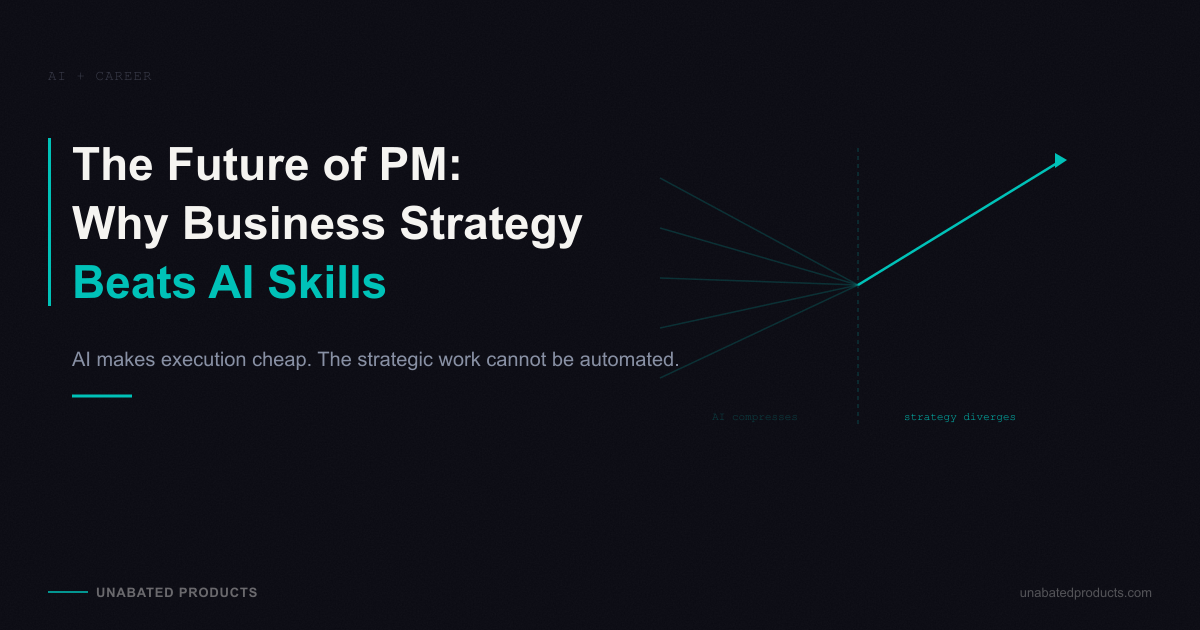
AI compresses the skill gap at the bottom. Every PM with Claude can write a PRD that looks senior. But the strategic work that actually moves products forward cannot be automated. The PM role is splitting in two, and you get to choose which side you are on.
I've been putting AI into products since 2009. I'm not saying that to impress you. I'm saying it because when people ask me if AI will replace PMs, I've had 17 years to watch what it actually does to product roles.
AI makes execution cheap. Spec writing. Data analysis. Customer call summaries. Competitive research. PRD generation. Wireframe creation. All of it approaching zero marginal cost.
All of those are delivery tasks. And delivery was already the part of the job most PMs were decent at.
The real question isn't whether AI changes product management. It already has. The question is which parts of PM work become more valuable as AI handles the rest.
The compression effect
A first-year PM with Claude can produce a PRD that looks like a third-year PM wrote it. Clean formatting. Complete sections. Professional language. The output quality gap between junior and mid-level execution work has compressed to near zero.
I put it this way to Ray Kearney, a product and experience leader with 15 years in consulting and in-house product work: tools like Cursor and CloudCode are already replacing product managers who only write specs. The tools aren't smarter than people. Writing specs was just never the hard part. Knowing which spec to write was.
When everyone can produce the artifact in 10 minutes, the artifact has zero signal value. It tells a hiring manager nothing about whether this PM can actually drive outcomes. The differentiation has to come from somewhere else.
Where AI hours actually go
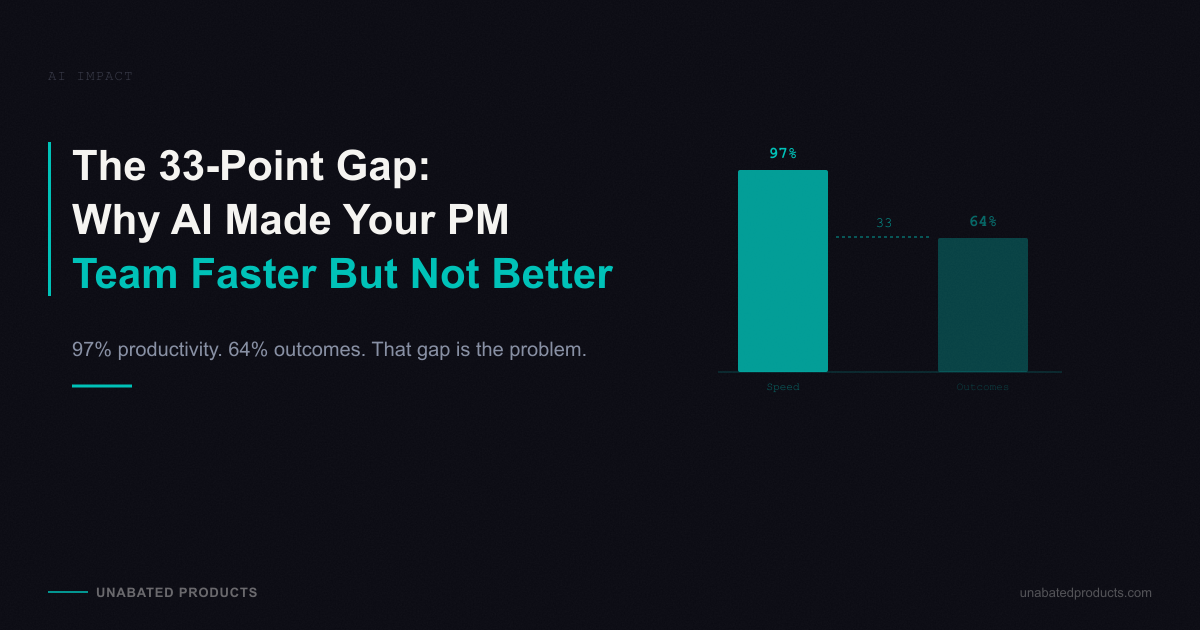
The Product Focus 2026 Survey found that 97% of PMs say AI improved their personal productivity. Only 64% say it improved their product outcomes. That 33-point gap tells you something important about how PMs are using these tools.
Ant Murphy's 2026 analysis of AI usage patterns among PMs makes the gap concrete. 21.5% of AI time goes to writing PRDs. 19.8% goes to building mockups. Data analysis, customer call summaries, competitive research. All delivery work.
Roadmap strategy? 1.1%.
User research? 4.7%.
PMs are using AI for the work their companies already know how to measure. Sprint velocity. Feature completion. Spec quality. Those metrics are visible, trackable, and rewarded.
The strategic work that actually moves product outcomes is invisible to most performance systems. Nobody gets a bonus for "connected the roadmap to the P&L." Nobody gets promoted for "killed a feature the VP requested because the unit economics did not work." So that work doesn't get AI-augmented. In many organizations, it doesn't get done at all.
AI didn't create this pattern. It accelerated it.
Do not position yourself as an "AI PM"
A PM finishing her master's degree asked me if she should position herself as an "AI product manager."
I told her no.
Six months ago, the hot resume keyword was "evals and MCP servers." Before that, "prompt engineering." Before that, "machine learning pipelines." Before that, "data science." Each wave peaked and then got absorbed into the baseline expectation.
That's what happens with tools. They start as specializations and end as assumptions. Excel was a specialization in the 90s. Now it is assumed. AI tools are following the same path, just faster.
Nobody calls themselves a "Spreadsheet PM." AI will be that invisible and ubiquitous within two years.
What made this PM actually valuable wasn't knowledge of a specific AI tool. It was 5 years of experience across fintech, marketplaces, ML pipelines, and cloud platforms. She had worked in environments where the tech stack changed every 18 months and she adapted every time.
I told her to stop marketing the tool and start marketing the pattern. "I've worked across 4 different technical environments and delivered in each one. When the tools change, I don't slow down."
She shifted from "AI PM" to "growth PM for multi-sided marketplaces who uses AI tools." Specific on the problem she solves. Generic on the tool. Much harder to commoditize.
Positioning that leads with a tool name has a shelf life. Positioning that leads with a problem you solve outlasts any tool cycle.
The role is splitting in two
In January 2026 I went through PM job postings and kept finding the same role. Apply Digital's Senior Product Manager listing asked the hire to "own the product delivery and execution" and to "plan and manage delivery sprints." 360Learning's Product Manager listing asked for someone to "write features specifications and user stories" and to "manage the roadmap and product backlog of your squad." CallRail's asked for someone to "manage the daily workflow with a sprint team."
Backlog grooming. Sprint management. Writing specs. Coordinating between engineering and design. Maintaining the JIRA board. Those postings used the title "Product Manager" but described a project coordinator. The actual strategic work was not in the job description. It was assumed to come from somewhere above.
That split has been building for years. AI is accelerating it.
On one side: process managers. They run the system, keep the trains on time, and keep stakeholders informed. Organized and reliable. Most PM education trains you for this role. And AI is about to make most of it unnecessary.
On the other side: strategic owners. They decide which trains should run and which tracks should be built. They connect product decisions to business outcomes and speak the language of the CFO. They understand incentive systems and unit economics well enough to argue for budget in a finance review.
The middle ground is disappearing. When tools handle spec writing and backlog management and status updates, what's left? You're either the person making the strategic decisions or you're competing with software for the coordination work.
Why business strategy wins
The most common version of stuck I see is a PM with the better part of a decade of excellent delivery work behind them. Features shipped on time. Sprint targets hit. Consistently positive performance reviews. And still the feedback comes back: be more strategic.
They aren't less strategic than their peers. They're in a role that uses the PM title but doesn't include the strategic work. The title inflated while the actual responsibility stayed the same.
AI makes this gap painfully visible. When delivery work takes a fraction of the time it used to, the PMs who only did delivery work have a lot of empty hours. The PMs who were also doing strategic work have more time for the part of the job that actually matters.
The strategic skills that get more valuable as AI gets better:
Business ownership. Understanding how the company makes money and how your product contributes to that. Connecting feature metrics to user outcomes to business results. Speaking the language of the CFO.
Stakeholder navigation. Reading the incentive system in every room. Knowing what would get each person fired and positioning your product work accordingly. Building coalitions for hard decisions.
Customer depth. Understanding customer behavior at a level AI can't replicate because it requires judgment about context, relationships, and unspoken needs. The customer insight that changes product direction rarely comes from a transcript summary. It comes from the PM who noticed something that contradicted the data.
Strategic storytelling. Making the case for why this product direction, not that one. Building a narrative that connects user pain to business opportunity in language that different audiences understand.
Cross-functional leadership. Aligning engineering, design, sales, marketing, and finance around a shared direction when each team has different priorities and success metrics.
None of these skills get automated, and every one of them gets more valuable as execution becomes cheap.
What to do about it
If your daily work is mostly coordination, documentation, and stakeholder status updates, you're on the process side of the split. That's not a judgment. It's a fact worth knowing because the window to shift is still open.
Start by quantifying your impact in business terms rather than delivery terms. Not "shipped 12 features last quarter." Instead: "The features I shipped contributed to a 15% reduction in enterprise churn, which represented $1.2M in retained ARR." The business frame forces you to think about why you built something, not just that you built it.
Learn the language your CFO uses. Revenue, margin, acquisition cost, payback period, contribution profit. These are descriptions of the same reality you already understand. You know why customers churn and which features drive retention. The CFO knows those things too. They just use different words.
Connect every piece of product work to a business result. Feature influences metric. Metric influences user outcome. User outcome influences business result. If you can't draw that line, the work might be necessary, but it's not strategic work. And the AI can probably do it without you.
The PMs who build durable careers over the next five years won't be the ones who learned the most AI tools. They will be the ones who used the time AI freed up to do the strategic work that nobody can automate. Business ownership, customer depth, stakeholder navigation, and the ability to make a case for why this investment matters in language the people with budget authority actually use.
The role is splitting. You get to choose which side you are building skills for.
The Influential PM is a 3-week live cohort for B2B PMs who want to operate at the strategic level. Get the career results that follow.
Former VP of Product at a Big 4 firm. Has coached 500+ PMs across Fortune 500 companies. Teaches the Influential PM cohort on Maven.