The Strategic PM: Stop Being Tactical, Start Driving Business Outcomes
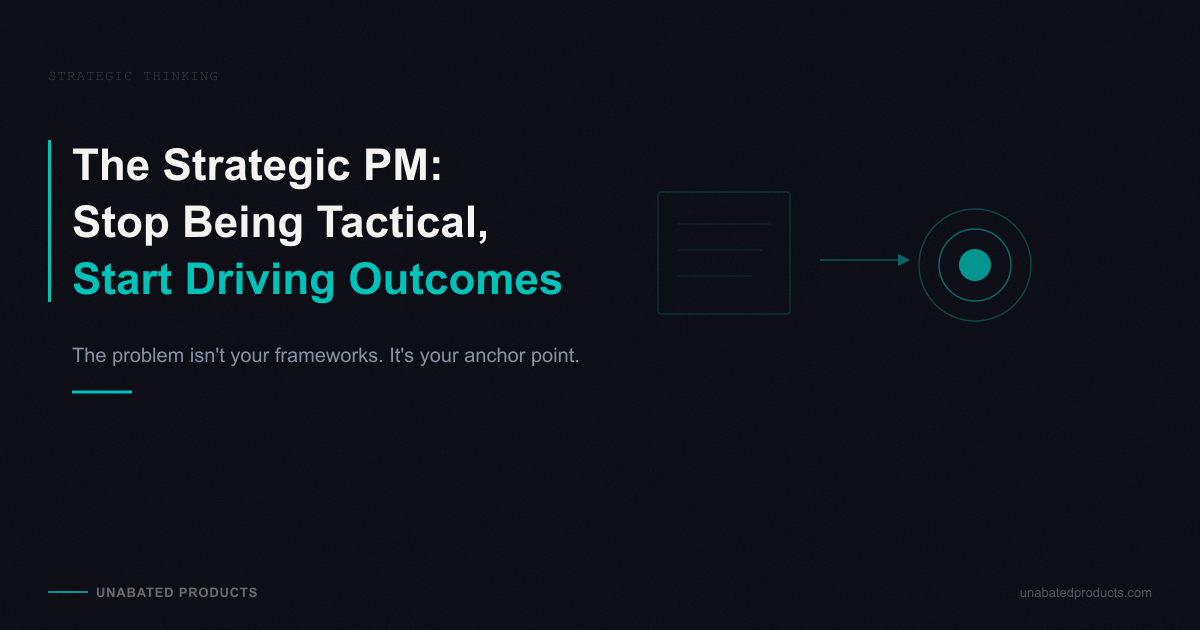
You've tried the frameworks. You understand Jobs to Be Done, OKRs, and product strategy theory. You still feel tactical. The problem isn't your frameworks. It's your anchor point. Here's how strategic PMs actually think differently.
You've been trying to be more strategic.
You've studied OKRs. You've read about Jobs to Be Done. You've watched talks on product vision and roadmap prioritization. Maybe you've taken a course.
You still feel tactical.
Your days are still feature requests and sprint reviews and stakeholder asks. You're still in the weeds. The "strategic" version of your role feels like something that happens in other people's meetings.
The problem isn't your frameworks.
You know enough frameworks. The problem is your anchor point.
What strategic actually means
Most PMs describe "being strategic" as thinking bigger, looking further ahead, or saying no to things. Those descriptions are true in some narrow way. But they're not the root of it.
Strategic PMs anchor every decision on one question: what outcome does my customer need to succeed?
Not what feature should I build. Not what does my stakeholder want. Not what will move my north star metric. What does my customer need to succeed in their job, their business, their goals?
That's the anchor. And most PMs never set it.
They anchor on features. Their days are organized around the backlog. Every prioritization conversation is about what to build next. Every sprint review is about what shipped.
That's not strategic work. That's implementation management with a PM title on it.
Kiran Kumar Banothu had nine years of experience across startups, consulting firms, and enterprise work when he came to me. He'd grown a startup from $1M to $10M. He'd covered all four pillars of product management: strategy, delivery, customer experience, and growth. He had more actual PM work experience than most people with senior PM titles.
But when he tried to interview for strategic PM roles, nothing converted.
"Theoretically and strategically, I'm there," he told me. "I did the job, I could connect all the dots." He just could not convince anyone of it, not through his resume and not in the interview.
The issue wasn't his experience. It was his framing. He was describing what he'd built. He wasn't describing what his customers had been able to accomplish because of it. One framing is a delivery log. The other is a strategy story.
The anchor point shift
When I work through this with PMs, I use a simple exercise. Take your current project. Start at the top.
Your customer has a goal. It might be: our pharmaceutical clients need to navigate new regulations without hiring expensive consultants. Or: our artists need to reach their audience without needing a distributor. Or: our enterprise sales team needs to close more APAC deals.
That's your anchor. Not your roadmap. That goal.
Now work backward. What would your customer need to be able to do to achieve that goal? What's in the way? What does your product currently help with? What is it leaving unaddressed?
Every feature you build should have a clear line from "this feature helps our customer do X" all the way through to "and when they do X, they can achieve their goal." If you can't draw that line, the feature might be right. But you're building it for the wrong reason, and you'll never be able to explain why it mattered.
That is the anchor I gave Kiran for his project at a music streaming service. That platform's goal is to help artists produce and disseminate their content, so his job is to help the platform finish that job. Set the anchor there and the prioritization question changes. You stop evaluating a feature request against backlog priority and start evaluating it against one question: does this help artists succeed at their core job?
That's the shift. Same product. Same team. Same data. Different anchor.
Three behaviors of strategic PMs
Strategic thinking isn't a personality type. It's a set of habits. These are the three that show up most consistently in the PMs who make the shift.
1. They start every conversation with the customer outcome
Before any prioritization meeting, any stakeholder session, any sprint planning, strategic PMs set the anchor out loud.
"We're building this product to help [customer] achieve [outcome]. Everything we prioritize this quarter should move us closer to that. Let's start there."
This sounds obvious. Almost nobody does it.
Most PMs start sprint planning by opening the backlog. Most prioritization meetings start with "here are the candidates." By the time you're 20 minutes in, the conversation is about implementation details and everyone has forgotten why any of it matters.
Setting the customer outcome anchor at the start pulls every subsequent conversation back to it. When someone suggests a feature, the question isn't "can we build it?" It's "does this help our customer achieve the outcome?" That's a completely different conversation.
2. They know the revenue model before they touch the roadmap
Strategic PMs understand how their company makes money. Not in abstract terms. In specific ones.
How does your product generate revenue? What does a customer pay for? What metric, when it goes up, directly improves your company's P&L? What customer behavior, when it stops, causes churn?
If you can't answer those questions, your prioritization is guesswork. You might be optimizing a feature that costs more to operate than it generates. You might be ignoring a capability with 10x better unit economics than your current priority.
The chain I drew for Kiran ran like this: his job on that project was to help the platform help artists succeed, and when artists succeeded, the platform made more money. The chain already existed. Nobody had made it explicit.
When you know the revenue model, every feature evaluation has a business case built in. You stop asking "should we build this?" and start asking "what's the expected return on building this versus the alternatives?" That's strategic prioritization.
3. They think in options, not features
Tactical PMs come to stakeholders with one answer. Often the one the stakeholder asked for.
Strategic PMs come with options. Three paths. Each with tradeoffs.
Option A: fast, low-cost, addresses the immediate symptom, doesn't solve the root cause.
Option B: medium investment, addresses the root cause, takes three weeks.
Option C: strategic investment, solves this problem and two related ones, takes six weeks but has 4x better expected return.
When you present options, you change the entire dynamic of the conversation. You're not seeking approval. You're enabling a decision. The stakeholder's job becomes choosing which bet to place, not telling you what to build.
And when a stakeholder chooses an option, they've committed to it. They've made a decision. They own part of the outcome. That's very different from them assigning you a task.
Why tactical PMs stay tactical
Most companies don't reward strategic thinking. They reward delivery. Shipped features, sprint velocity, quarterly roadmap hits. These are easy to measure and they feel like progress.
Strategic thinking is harder to see. You can't put "anchored every feature to customer outcome" in your OKR. You can't track "brought options instead of answers" in a spreadsheet.
So tactical PMs get promoted first, get hired first, get recognized first. For a while.
At some point, usually around the 5-year mark, the delivery signal stops differentiating. Everyone at senior level ships reliably. The new question becomes: which of these PMs thinks like a business owner? Which one can explain not just what they built but why it was the right bet for the company to make?
That's when the anchor point matters.
The PMs who stay tactical fall further behind every year. Their execution stays the same. The bar moves.
The PMs who make the anchor shift start compounding. Every feature they build adds to a story about customer outcomes and business impact. Every prioritization decision is traceable to a strategic bet. Their career narrative writes itself.
The shift isn't complicated. But it requires breaking the habit of starting with the backlog and building the habit of starting with the outcome.
◆
Most PMs describe their strategic thinking clearly inside their own heads. The gap is making it visible to the people who decide promotions. A 5-minute diagnostic shows you where you're connecting customer outcomes to business impact versus where you're still reporting features. Take the Business-Lens PM Diagnostic.
◆
Related reading:
- What Actually Gets Product Managers Promoted (It's Not Shipping More): the specific behaviors that separate mid-level PMs from senior
- Product Manager Business Acumen: The Skill That Separates Senior PMs: how to build the business translation habit that makes strategic thinking visible
The Influential PM is a 3-week live cohort for B2B PMs who want to operate at the strategic level. Get the career results that follow.
Former VP of Product at a Big 4 firm. Has coached 500+ PMs across Fortune 500 companies. Teaches the Influential PM cohort on Maven.