Financial Fluency for Product Managers: The Skill Nobody Teaches
If you've been trying to talk to executives and struggling to make your numbers land, the gap isn't presentation skills. It's financial fluency. Most PM courses never teach it.
A founder built an online comic book distribution platform. Customer acquisition was working. The product was functional. The website looked good.
The business was dying.
Postal subsidies were killing it. Competition and product quality had nothing to do with it.
Akhil was a mathematics student at NYU who started an online comic book store. The unit economics looked straightforward. A comic book retails for about $4. He sold at a 40% discount from MSRP, which gave him roughly 20% gross margins. He figured that would work if he could get enough volume.
It didn't. Because the other $4 was shipping. A package from Texas to Illinois costs about the same as the product inside it. His actual cost to deliver a $4 comic to a customer was $8, and he was selling it for $2.40. Every sale lost money.
He noticed Instagram ads from other companies selling $2 products with $1 shipping. How? He did the research and discovered that the Universal Postal Union, which manages international shipping rates between countries, gives China a subsidy classification as a developing nation. USPS subsidizes the last-mile delivery within the U.S. for those shipments.
The result: it was cheaper to ship a product from China to an American customer than to ship that same product from Seattle to Illinois.
Akhil called his comic book distributor. All their distribution centers and warehouses were in China. If he set up a warehouse there and shipped direct, his unit economics would flip. But executing that as a solo college student was a different problem entirely.
His takeaway: "I thought I was in the business of attracting customers. What I realized is I was more of a shipping company."
That single sentence is financial fluency in action. Understanding your cost structure reveals what business you're actually in.
The skill gap PM training ignores
Product management education focuses on the demand side. Customer discovery, prioritization frameworks, stakeholder management, roadmap planning. All of that matters. But most PM training completely ignores the supply side: the cost structures, margin dynamics, and financial constraints that determine whether a product can actually survive.
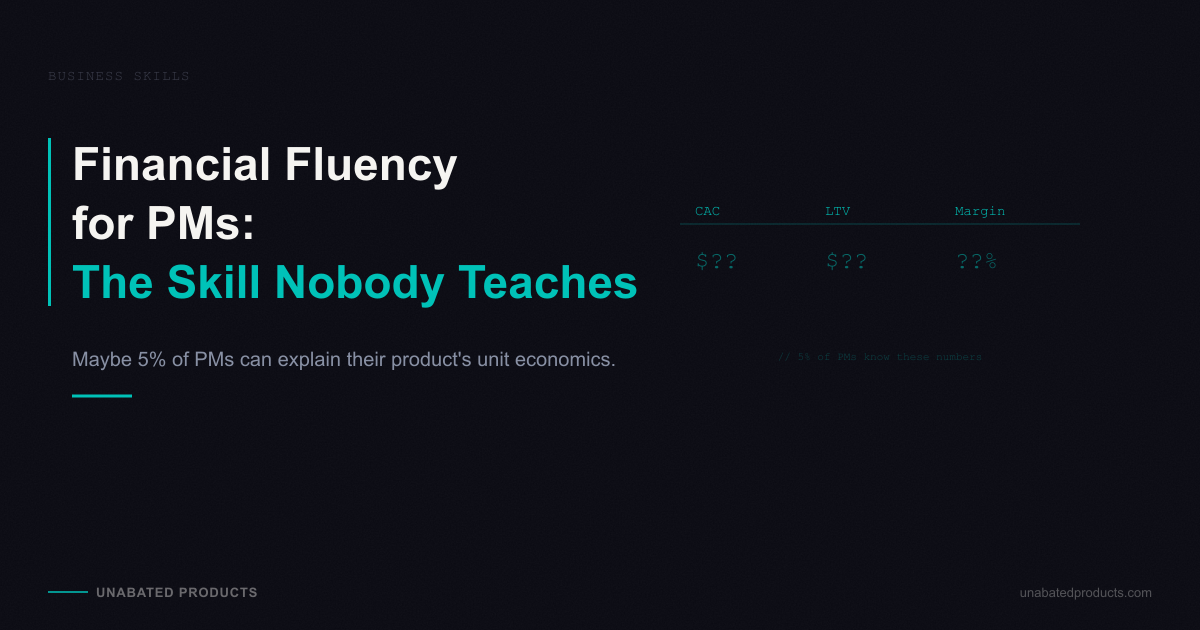
I've coached over 500 PMs. Maybe 5% of them could explain their product's unit economics. Fewer could read a financial statement. Almost none had ever looked at their company's SEC filings, investor letters, or earnings calls.
This isn't a gap in technical skill. It's a gap in perspective. A PM who only understands demand knows what customers want. That's table stakes. The PM who also understands supply knows which of those wants will actually make money.
Akhil's story is extreme because he was a founder. But the same principle applies inside large companies. If you're building features for a product and you don't understand the cost of serving each customer, the margin on each transaction, or the revenue model that keeps the business running, you're making prioritization decisions with half the picture.
SEC filings are a treasure trove nobody opens
A PM at a global IT services firm was supporting a sales initiative. They were pitching to a pharmaceutical company and needed to understand the client's business. Most PMs would have read the company's website, looked at their product portfolio, and maybe checked a few press releases.
Larissa pulled their 10-K filing from the SEC database.
A 10-K is the annual report public companies file with the SEC. Business operations, financials, risk factors, competitive position. All public, all free. It tells you more about how a company actually runs than anything on their marketing site.
Larissa had been a financial planner before her MBA at Carnegie Mellon, and she'd spent two years at a venture fund doing investment research. She knew how to read financial statements. So she analyzed the pharma company's cash flow, liquidity, and R&D efficiency.
Two findings stood out. First, the company's return on research dollars was substantially lower than competitors. For every dollar they spent on R&D, they generated far less revenue than the industry benchmark. Competitors were beating them roughly 3 to 1 on R&D returns.
Second, their time-to-market for getting drugs from the pipeline to distributors was too long. The bottleneck wasn't research. It wasn't clinical trials. It was shipping logistics adding months to every product launch.
From those two findings, she recommended two specific products from her company's portfolio: one to optimize logistics and reduce time-to-market, and one to accelerate the drug discovery and compound patenting phase.
No customer interview could have surfaced those insights. No product discovery workshop would have found the logistics bottleneck. The answer was in the financial statements the whole time.
Most product managers don't know what a 10-K is. That's a competitive advantage for the ones who do.
Subscription economics tell you where the growth is
A PM at Temu (the e-commerce platform) was analyzing their membership program. Only 8% of users subscribed. The data showed that users who did subscribe generated more revenue than those who didn't. The business case for driving subscription adoption was obvious. The question was how.
She didn't wait for the user research team. She went to the street. Literally walked up to people and showed them the subscription page on her phone. Three things came back:
First, the page promised vouchers, but users didn't trust the promise. Second, the most valuable benefit (vouchers) occupied a tiny fraction of the page. The visual hierarchy was wrong. Third, heat map data confirmed it: users were clicking on the small voucher section more than anything else on the page.
Two changes. She made the voucher section more prominent. She added reviews from existing subscribers to build trust through social proof.
Subscription conversion went from 8% to 12%. A 50% relative improvement. She then built a second version of the membership from scratch that generated 12 million in incremental daily GMV.
This isn't balance sheet analysis. It's knowing the business model well enough to ask better questions. Why are subscribers more valuable? What's the revenue trade-off between per-transaction pricing and subscription pricing? If we convert more merchants from transactional to subscription, does total revenue go up or down in the short term?
She was preparing for an interview at a payments company navigating exactly this tension. Its point-of-sale hardware is the entry point, but the revenue comes from software subscriptions. Merchants who subscribe get lower per-transaction fees and more predictable costs. But it has to balance subscription growth against the risk of initially losing transaction revenue if the pricing model is wrong.
Most PMs would look at that business and ask what to build next. The better question: can the business model support what you're building?
Insights first, methods second
Financial fluency changes how you communicate, not just how you analyze. And the communication part is where most PMs blow it.
"I conducted 15 user interviews and synthesized findings into a PRD." That sentence tells me you did the work. It tells me nothing about what you learned.
"I discovered that 30% of users abandoned onboarding because they expected a feature we don't have." That tells me something useful. It tells me what changed your understanding. It gives me information I can act on.
The PM at Temu didn't just "do user research." She went to physical stores and discovered trust barriers that were invisible in the data. When she described the work, she led with what she found (users don't trust the voucher promise), not how she found it (I showed people the page on the street). The insight first, the method second.
One of the PMs I coached put it well when reflecting on resume writing: "It's like a movie trailer. Challenge, product, what you applied, and the result. If they get curious, they'll ask for more details."
That's the right frame. Your financial analysis, your data work, your research, all of it should lead with the surprising or important finding. Not "I analyzed the 10-K" but "I found that their R&D returns were 3x lower than competitors, and the bottleneck was in logistics, not research."
When you communicate this way, two things happen. People who are listening learn something. And people who are evaluating you learn that you think at a level above the task you were assigned.
The cost structure test
Quick self-diagnostic. Answer these questions about your current product:
What does it cost to acquire one customer? What does it cost to serve one customer for a month? What's the gross margin on a single transaction? If a customer churns after three months, did you make money or lose money?
If you can answer all four, you have a financial foundation. If you can't answer any, you're making product decisions without knowing whether your product can afford them.
None of those breakthroughs came from customer interviews, user stories, or prioritization frameworks. They came from understanding the money. How it flows in. Where it leaks out. What changes the equation.
You don't need to become an accountant. You need to understand your business well enough to see the opportunities that demand-side-only PMs miss.
Start with your company's financial statements if they're public. Read the 10-K. Look at the earnings call transcript. If you're at a private company, ask your finance team to walk you through the unit economics. Most of them will be thrilled that a PM is asking.
The product roadmap tells you what the PM team cares about. The financial statements tell you what the business actually needs. The gap between those two is where the best product work happens.
◆
Keep reading: Financial fluency is one piece of business acumen for product managers. The other piece is understanding the incentive systems that determine which financially sound proposals actually get approved. Both come due the moment you have to defend what you measure, and the first thing to get right there is that adoption should never be your North Star metric.
Want to see where you fall? Take the free 5-minute PM Diagnostic.
The Influential PM is a 3-week live cohort for B2B PMs who want to operate at the strategic level. Get the career results that follow.
Former VP of Product at a Big 4 firm. Has coached 500+ PMs across Fortune 500 companies. Teaches the Influential PM cohort on Maven.