What Actually Gets Product Managers Promoted (It's Not Shipping More)
You've shipped on time. Hit your OKRs. Your stakeholders are happy. And you still didn't get promoted. The feedback is always the same: "more strategic thinking." Here's what that actually means and the four behaviors that differentiate PMs who advance from PMs who plateau.
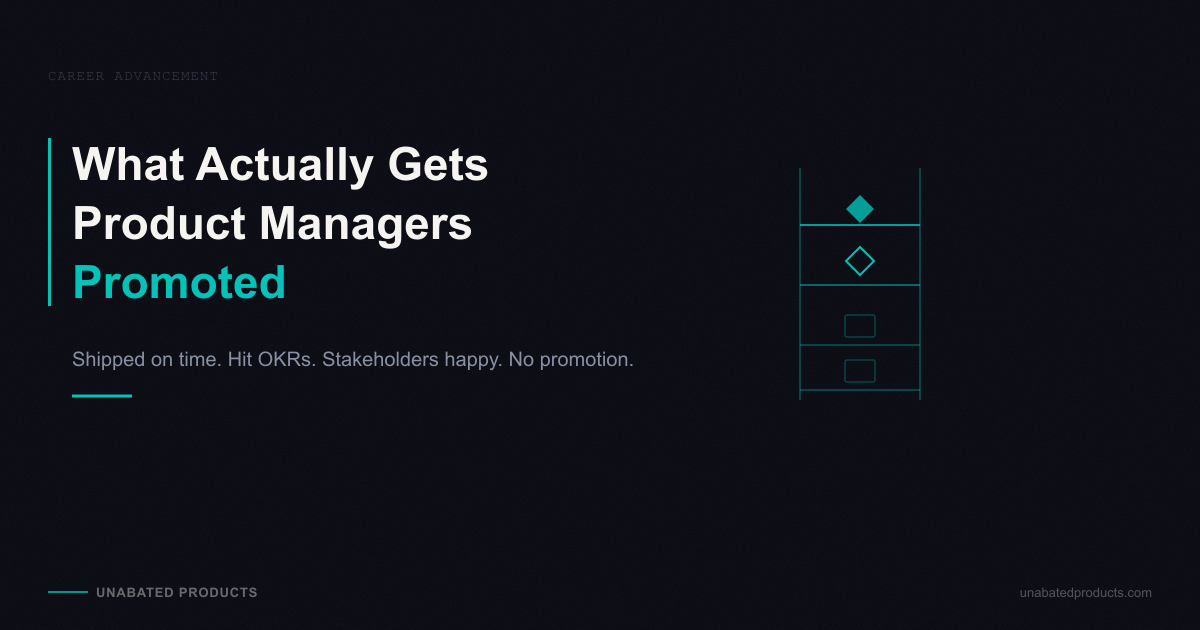
You shipped on time. All quarter.
You hit your OKRs. Your stakeholders are satisfied. Your manager says you're doing great work.
And you still didn't get promoted.
When you asked for feedback, you heard some version of this: "You need to show more strategic thinking." Maybe "take more ownership." Maybe "connect your work to the bigger picture."
You nodded. But you have no idea what any of that actually means.
I've coached over 500 PMs. This is the most common situation in the 3-10 year career bracket. And the feedback is always vague for the same reason: the people giving it often can't articulate what they're actually looking for.
So let me articulate it.
When delivery stops getting you promoted
There's a level in every PM career where delivery stops being the differentiator.
At the junior level, shipping reliably is the signal. It says: you can be trusted to execute. That's what gets you from associate to PM.
At the mid level, shipping reliably is the baseline. Everyone does it. It's expected. If you're still being evaluated primarily on delivery, you've hit the point where delivery alone stops getting you credit. You're doing the job correctly and getting no credit for it, because doing the job correctly is no longer what the role is for.
The role at senior level is not to ship well. It's to ship the right things and explain why they were worth shipping in language that matters to the business.
That difference, the translation from delivery to business impact, is what "more strategic thinking" actually means.
Most PMs who plateau at mid-level are excellent at the first part and invisible on the second. They ship. Nobody above them can connect what they shipped to any outcome the company cares about. So when promotion time comes, the question is "why do we need a more senior version of this person?" and nobody has an answer.
What the data shows
Across my coaching practice, I have tracked 36+ career advancements within 12 months of finishing a coaching engagement. Some had 3 years of experience. Some had 9 years.
The ones who got promoted had one thing in common. It wasn't their company. It wasn't their product domain. It wasn't their communication style or their confidence or their credentials.
They had all learned to translate their work into business language before presenting it.
That's it. Every promoted PM had made the shift from "here's what I shipped" to "here's what it was worth to the company." The ones who didn't get promoted were still reporting delivery.
A product director I coached had a good relationship with his CEO and a team that had spent years watching the roadmap bloat.
He couldn't get his CEO to stop throwing features onto the roadmap.
He came to me frustrated. He'd been pushing back on every feature that didn't have user research behind it. He thought the CEO "lacked a product mind." He was confident in his user-centric approach.
What he hadn't done: connect any of his product decisions to the metrics his CEO actually cared about.
The CEO was focused on what would attract investors. He was running a fundraise. His job was to make the company look like it was executing on something worth funding. The director I coached was solving user problems. His CEO was closing a round.
"Every product narrative starts somewhere," I told him. "You start with users. But it has to end with the business. If you can't get from the user problem to the revenue implication, you're speaking in a language your CEO can't hear."
I walked him through what I call the Product Metrics Ladder. Connect the feature to the user task it enables. Connect the user task to the customer company's success. Connect that success to your company's business outcome. Every conversation, every meeting, every roadmap update, bottom to top.
What the framework gives you is a language to respond with, one that isn't pushback. Instead of arguing about user research, you connect every product decision to the metrics your CEO cares about.
Four behaviors that differentiate promoted PMs
1. They translate before they report
Every product metric has a business metric behind it. Promoted PMs make that translation explicit before they say anything to stakeholders.
Retention went up 12%. What does that mean in revenue? If average annual contract value is $18K and you have 400 accounts, a 12-point retention improvement is worth $864K in protected revenue.
Support ticket volume dropped 25%. What does that mean in cost? At $14 per ticket and 3,000 monthly tickets, that's $10,500 per month in reduced operating cost.
Active users grew from 8K to 12K. What does that mean in growth? If your company charges per seat or grows by expansion revenue, 4,000 new active users at an average $40/month is $160K in monthly revenue growth.
The numbers are already in your product data. The translation is what's missing.
2. They own the investigation
Mid-level PMs ask stakeholders to justify their requests. Senior PMs take the investigation off the stakeholder's plate.
The difference sounds small. It's enormous.
"Can you share the data on that?" puts the work on the stakeholder.
"Give me until Thursday. I'll pull the data and come back with findings." puts the work on you.
When you own the investigation, you come back with the framing. You decide what information matters and how to present it. You become the authority on what should happen next. That's strategic ownership. And it's what separates PMs who get promoted from PMs who get stuck.
3. They bring options, not requests
Order-taker PMs bring one solution. The one they were asked to build.
Senior PMs bring three options with tradeoffs. Option A: the fast fix. Option B: the right fix. Option C: the strategic bet.
Each option has an estimated business impact. Each has a cost. Each has a risk.
When you show up with options, the stakeholder's job changes. They stop being the person who decides "yes" or "no" on your roadmap. They become the person choosing which bet to place. That's a completely different conversation. And it signals that you're thinking above the feature level.
4. They make their impact visible in business terms
This one is invisible until you understand it.
Most PMs do great work that gets attributed to the team, the product, or the company. They don't make the connection between their specific decision-making and the business outcome explicit.
Promoted PMs do.
They don't say "we launched the new onboarding flow and it reduced drop-off." They say "I diagnosed that 28% of new users were dropping during the payment step because of a field-label confusion. I proposed a two-week fix over a three-month redesign, we shipped it, and it reduced drop-off by 40%, which recovered approximately $300K in annual revenue we were losing to that one friction point."
Same outcome. Completely different attribution.
Your promotion decision gets made in a room you're not in. The people in that room need a specific, memorable sentence that answers "what did this person do that was irreplaceable?" Give them that sentence before they have to ask.
The thing nobody says out loud
Companies promote PMs who make their executives look good.
That sounds like executive self-interest, but the real signal for "strategic PM" is simpler: this person makes my decisions easier. They bring me what I need to say yes confidently. They don't bring me problems. They bring me options and a recommendation.
That's what "more strategic thinking" actually means. It means: you don't just execute well. You make the execution worth doing and you prove it in language that the company already speaks.
You probably have more strategic thinking than you're getting credit for. You're just not translating it yet.
◆
Most PMs who plateau at mid-level are translating well on delivery metrics and invisible on business outcomes. A 5-minute diagnostic shows you exactly where the gap is. Take the Business-Lens PM Diagnostic.
◆
Related reading:
- Product Manager Business Acumen: The Skill That Separates Senior PMs: how to build the translation habit and make it automatic
- How to Talk to Executives as a PM: the specific language and frameworks for executive conversations
The Influential PM is a 3-week live cohort for B2B PMs who want to operate at the strategic level. Get the career results that follow.
Former VP of Product at a Big 4 firm. Has coached 500+ PMs across Fortune 500 companies. Teaches the Influential PM cohort on Maven.