Product Manager vs Project Manager: Which Job You Have
Product manager vs project manager, stated plainly: one answers how and when work ships, the other figures out which work is worth doing. A test for your job.
A senior design team lead told me several times in the first few minutes of our session that strategic planning was one of his strengths. He ran design projects end to end, and he wanted to move into product management. So I asked him what the strategic planning looked like when he was doing it. The work arrived as Jira tickets, he said, and his job was to decide how to deliver them at the right quality, inside the deadline, with the designers he had available. That is good work, and it is project management.
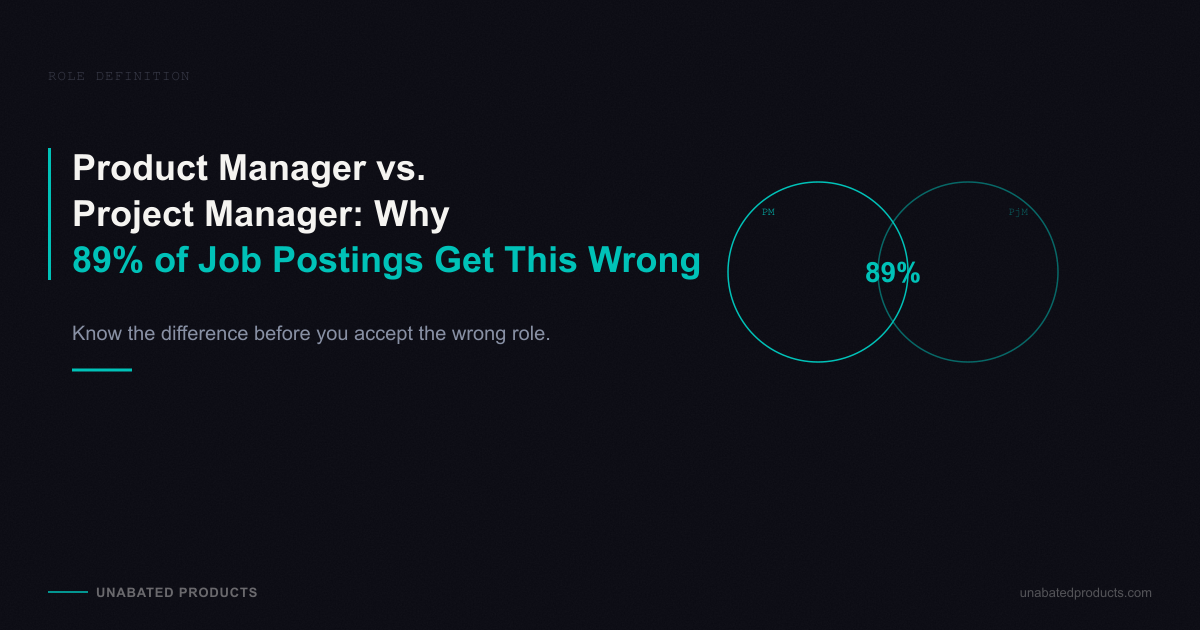
I get the product manager vs project manager question often enough that I send my cohorts an addendum on it. A project manager answers how and when the work gets done, and a product manager figures out which work is worth doing by discovering customer problems worth building a business around. Both are real jobs. They are also different jobs, and plenty of people hold the title of one while doing the work of the other.
Product manager vs project manager, by the question each one answers
When I advise executives on which role to hire, I describe three jobs, because the program manager sits between the other two.
You hire a project manager to achieve planned delivery. Someone has already decided what gets built. The project manager plans the tasks, monitors the timeline, and works with the team to hit the deadline at the right level of quality. The people who are great at it are thorough, organized, and comfortable with urgency, and they think in days to weeks. A program manager answers a bigger version of how and when. There are many teams now, so the question becomes when X has to start so that Y can start.
You hire a product manager when the direction is still undefined. The question is what our customers need from us that we don't serve them today. The outcome is some kind of success for the customer, which then becomes success for us. That takes thinking in years. It also takes being comfortable walking into complete uncertainty with no one telling you what to do.
Say an executive tells you the board is worried that you don't have a mobile app yet, and asks you for a plan. If your whole reply is "Absolutely. Do you have a launch date in mind, and is this iOS or Android first?" then you have accepted the solution and started gathering requirements, which is the order taker response. There was no uncertainty left in that conversation for a product manager to work on.
Titles get confusing because companies merge these jobs together. They combine a business analyst with a project manager and call the result a product manager. That leaves a person managing delivery with a fancier title, and probably more pay, than the impact they are allowed to have. I once made a cynical comment to a tech leader at one of my clients about people working as delivery managers. "I like that label," he told me, and he said he was going to start calling people delivery managers. That was not my point. But he was probably right that it is better to name the job accurately than to hand someone a product manager's expectations without the autonomy or the challenge.
The four pillars test
A title will not tell you which job you have, and neither will the word "strategic" on a resume. So I use a different test. Product management has four pillars, and a product manager is on the hook for the outcomes in all of them.
- Product strategy narrows every possible thing you could do (a new market, a different kind of customer, web, mobile) down to a single customer problem to bet on.
- Product delivery expands that bet into all the details, builds it, and then measures whether it had the impact you intended.
- Customer experience makes the complicated solution simple again, so it is easy to understand, easy to use, easy to support, and easy to buy.
- Adoption and growth puts the product in front of the market, motivates the right customers to adopt it, and feeds what you learn back into the strategy.
Now lay a project manager's job over those four. All of it sits inside product delivery, and it covers only part of that pillar. A project manager's goal is to deliver what was planned, but a product manager has a different goal in delivery. You give the team enough clarity about what success looks like that they can figure out several ways to solve the problem. Then you prove that what they built solved it. If your delivery work ends on the day the feature ships, you are doing the project manager's half.
So take the work in front of you and sort each piece under one of the four. It works on your own calendar, and it works on a job posting. In January 2026 I went through PM job postings and kept finding the same role. One senior product manager listing asked the hire to lead an established agile team, groom and prioritize the backlog, write user stories, and define acceptance criteria, and every one of those lines sorts under delivery. None of them asks which customer problem is worth betting on, or whether anyone bought the result.
The design lead's work sorted the same way. He had been promoted twice in about a year, to team lead and then to senior team lead, and all of the work he described to me sat under delivery, which is why putting "strategic" in front of "planning" had not changed what the work was.
Most of the product managers I work with are strongest in delivery. That is okay, because delivery is where nearly all of us start. It is also how a team becomes a feature factory, because the more you deliver, the more you are expected to deliver. The four pillars can look overwhelming the first time you see them, and people tell me they feel like they have to do all the things. You don't. The job is to choose where your time will have the largest effect right now. One quarter that might mean three months of making sure the sales team can sell what you already built. Another quarter you put your head down and build.
One pillar over
When I finished walking him through the three roles, he told me he understood the difference. He wanted the business side. He did not want to stay the person who tells everyone "this is the timeline."
My advice was that he did not need the title to start practicing. His company had an internal tool that the designers and copywriters used to check the status of their work, so I suggested he treat those people as his market. Interview them. Watch them work (that is called observation). Then draw the steps they take to get their own job done, which is different from drawing the buttons they click inside the tool. That drawing shows where the tool helps the work and where it adds friction. I also warned him that it might not be appreciated, because somebody can always say "that's not your job."
In class I describe that same move in two directions. You can go downstream into customer experience and measure whether the product is working for the people who use it. Or you can go upstream into strategy and learn how the decisions on your roadmap got made. You have to understand a strategy before you can influence it. DO NOT start by announcing that you are the CEO of your product and saying no to requests. When someone already has authority over you, a no comes across as defensive. The person who trusted you to deliver starts to wonder whether they can still rely on you.
What to do this week
Open last week's calendar and write one of four words next to every meeting and every deliverable: strategy, delivery, experience, or growth. Then count them. (If you are weighing an offer, sort each line of the responsibilities section the same way.) If nearly everything says delivery, you have a project manager's week no matter what the title says. You also know which pillars are empty.
Then pick the last feature you shipped. Find out whether it improved anything for the customer who uses it and for the company that paid to build it. Nobody has to approve that question, and it moves you one pillar over.
A company can retitle a project manager as a product manager in an afternoon, and that person will still spend Monday answering how and when. Nothing changes when you only change the titles.
-Brennan
◆
Want to practice all four pillars on YOUR current work, with a coach? Join the next cohort of The Influential PM.
The Influential PM is a 3-week live cohort for B2B PMs who want to operate at the strategic level. Get the career results that follow.
Former VP of Product at a Big 4 firm. Has coached 500+ PMs across Fortune 500 companies. Teaches the Influential PM cohort on Maven.