How to Build PM Influence in Your First 90 Days
If you've been trying to prove yourself fast in a new PM role and wondering why nobody listens yet, the problem isn't your ideas. It's your 90-day strategy.
A PM joined a global payments company six weeks ago. She was working on real-time clearing, a product that had already been piloted in South Africa and needed to expand into new markets. Smart person. Strong background. Ready to contribute.
She wanted to demo the product in her first month. Show what she could do. Project herself, as she put it, "like a conference speaker."
I told her to wait.
She was plenty capable. But the demo that impresses is the one that solves the problem your VP is losing sleep over, not the one with the most features. And six weeks in, she didn't know what that problem was yet.
She admitted she understood about 40% of what people told her in 1-on-1 meetings. She didn't know who to meet outside the product team. She wasn't sure what questions to ask people in finance or operations who might respond with "what do you want to know?"
That's not a weakness. That's the starting position for every PM in a new role. The ones who acknowledge that gap build influence. The ones who skip it spend two years undoing first impressions.
Competence before confidence
The instinct in a new role is to prove yourself. Ship something. Have a point of view in the first strategy meeting. Demonstrate you were worth hiring.
That instinct is wrong. Shipping without context produces the wrong things. You optimize for visible output when what actually earns trust is visible understanding.
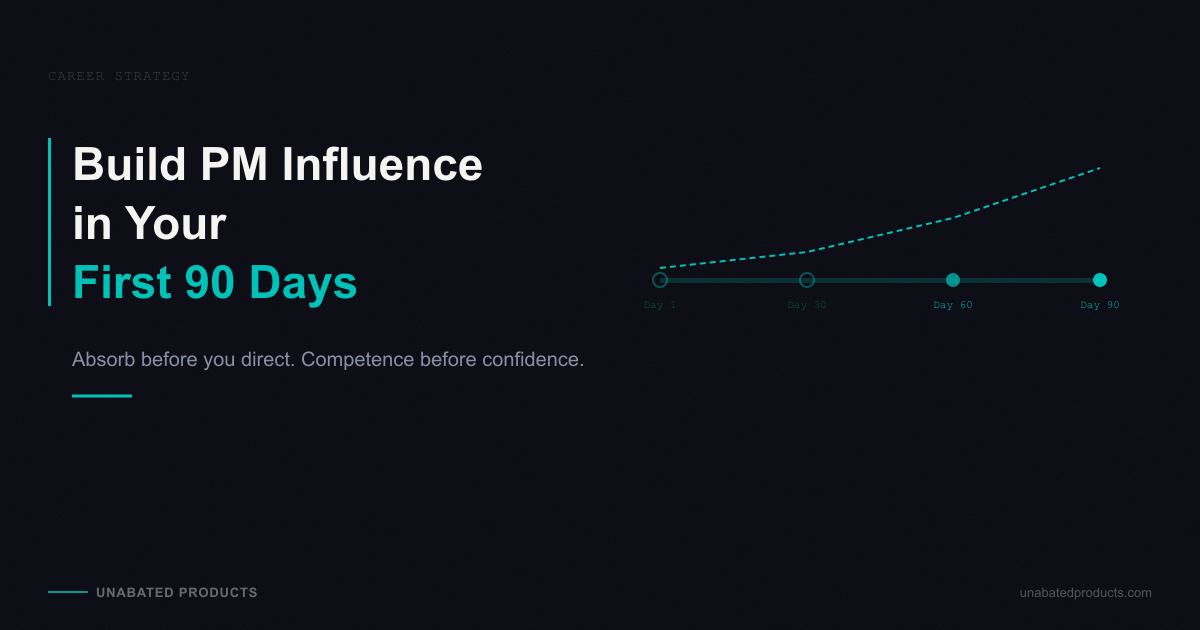
I gave this PM a different framework for her first 90 days. Three pillars, in order:
Gather market insights first. Who are the customers? What convinced the South African pilot customers to sign up? What were they promised, and does the product deliver on those promises?
Then learn the metrics of success. Not the KPIs on a dashboard, but the specific numbers that make your director look good or bad. The ones that get discussed in meetings you haven't been invited to yet. This takes more digging. You won't find these on a wiki page.
And then understand the existing strategy. Not the roadmap (that's execution). The actual strategic bets the company is making. Why real-time clearing instead of something else? What's the competitive differentiation? Where do they think the market is going? Most PMs skip this one because it feels abstract. But it's the one that makes you sound like you get it when you finally open your mouth in a strategy meeting.
Only after those three pillars have a foundation do you demo anything. And when you do, the demo addresses a specific customer problem you've identified through your research, not a feature tour you memorized from the product docs.
The warm referral chain
Big companies like that run on tribal knowledge. Critical information lives in people's heads, on their laptops, in documents you'd never find through any search tool or wiki. The only way to access it is through relationships.
But most new PMs either limit their 1-on-1s to other product people or send cold meeting requests that get ignored or result in awkward 30-minute conversations with no follow-up.
The approach that works is a referral chain. Meet person A on the product team. Let them talk for most of the 30 minutes (you're learning, not presenting). At the end, ask one question: "Who else should I talk to about this?"
Get a warm introduction. Now when you walk into the meeting with person B in finance or operations, you carry person A's credibility. Person B already knows someone you know and vouched for you. Repeat.
You're not networking. You're building an information map and a trust network at the same time. And the specific questions you carry from meeting to meeting get sharper each time.
After talking to a product leader about how customers pay for batch processing versus real-time clearing, you walk into finance with a specific question: "I heard customers pay differently for these two processing modes. Are we charging more for real-time, and does that change our margins?" That question signals that you already know something. Finance doesn't have to start from zero with you.
Six months later, when you need something from that person in finance, they already know you. The relationship was built before you needed it.
The promise versus reality audit
Most PMs in new roles focus on the roadmap. What are we building next? Where are the backlogs? Which sprints are upcoming?
A better first move is to read every piece of marketing material your company publishes about your product. Sales decks, landing pages, case studies, competitive battle cards. Then compare what's being promised to the market against what the product actually delivers.
The gap between promise and reality is your roadmap.
In my experience, marketing promises more than the product delivers about 80% of the time. The other 20%, engineering has built something useful that nobody in sales knows about. Either way, that gap is where your first real contribution lives.
One PM I coached at a startup learned this the hard way. Her company had gone from zero to $1 million ARR in under three months, but the product was, in her words, "built on very thin toothpicks." The data accuracy they promised clients didn't match reality. She'd demo the product, and two weeks later engineering would come back saying the numbers were off. She was repeatedly embarrassed in front of customers by data she couldn't trust.
If she'd done the promise-versus-reality audit earlier, she could have flagged the gap before it became a credibility crisis. Instead, she spent months firefighting something that was visible from day one if you knew where to look.
Proactivity is the differentiator nobody tests for
A PM I coached kept passing recruiter screens but failing final interviews. His skills were solid. His stories were solid. When I dug into what was missing, it was evidence that he spotted problems before being told.
I asked him: what's the difference between a good PM and a great one? He said a good one follows the job description. A great one finds problems before they become problems. He knew the answer intellectually. He just didn't have stories that demonstrated it.
This is what "exceeding expectations" actually means in practice: noticing something nobody asked you to notice, then doing something about it. Working longer hours and shipping more features don't qualify.
At his fintech consultancy, this PM managed client products (card issuing, similar to Revolut and Wise). He didn't own the product. The clients dictated requirements. But on his own time, he used competitor products, identified features his client's product was missing, and brought recommendations back without being asked. "I can bring features from here and go back to the client. We have these features. What do you think if we put them on the roadmap?"
That's proactive product management. And it works whether you're in your first 90 days or your tenth year.
Translate the CEO's vision, don't just execute it
Another PM I coached worked at an OKR platform where he had regular, direct interaction with the CEO. He was asked to build AI agents into the product. His resume described what he built. It said nothing about why.
I told him to flip the framing. The valuable skill wasn't building the AI integration. It was understanding what the CEO actually wanted and turning that into something engineering could ship.
Most PMs position themselves as execution machines. The ones who advance position themselves as translators. The CEO sees the big picture. Engineering sees the constraints. The PM who speaks both languages, who can turn "I want us to be the AI-first OKR platform" into a short list of product bets that engineering can actually build and leadership can actually measure, becomes the person everyone wants in the room.
You build this skill in the first 90 days by understanding how your leadership talks about the business. Not in all-hands meetings where messages are polished. In 1-on-1s where they're thinking out loud. Listen for what they're excited about. Listen harder for what worries them. That's where your highest-impact work lives.
The 3-month forcing function
I gave that PM a challenge: demo your product to a customer within three months. Not a practice demo to your team. A real demo to a real customer, addressing their specific problem.
That deadline forces everything else into alignment. You can't demo well without understanding the market. You can't address a customer's specific problem without understanding the stakeholder landscape. You can't present confidently without having done the 1-on-1s, built the relationships, and mapped the promise-versus-reality gaps.
It's also a concrete goal that your manager can see. "I'm spending my first 90 days learning" sounds passive. "I'm spending my first 90 days preparing to demo our product to a customer by week 12" sounds like a plan.
The PMs who build lasting influence don't try to impress in month one. They listen. By month three, when they finally present a point of view, it's grounded in relationships and context that nobody can wave away. Look, this might not work in a startup where you're the only PM and the CEO wants shipping yesterday. But at a company that size? You have the luxury of learning first. Use it.
Try this in your first week
Pick one person outside your immediate team. Not product, not engineering. Someone in finance, marketing, sales, or operations. Send them a specific question, not a general "I'd love to pick your brain" meeting request.
Something like: "I noticed our marketing says X about the product. How does that align with what you're seeing from customers on the sales side?"
That question does more work than most PMs' entire first week of meetings. You've shown homework. You've started a real conversation, not a networking checkbox. And you've kicked off the information map that drives your next 89 days.
Most PMs who get stuck in new roles tried to figure it all out alone. The ones who accelerate asked for help early, and they were strategic about who they asked.
◆
Keep reading: Influence starts with understanding the hidden incentive system driving decisions around you. The best PMs build influence through asking the questions nobody else thinks to ask. And the skill that makes influence permanent? Business acumen.
Want to see where you fall? Take the free 5-minute PM Diagnostic.
The Influential PM is a 3-week live cohort for B2B PMs who want to operate at the strategic level. Get the career results that follow.
Former VP of Product at a Big 4 firm. Has coached 500+ PMs across Fortune 500 companies. Teaches the Influential PM cohort on Maven.