A Product Strategy Template That Fits on One Slide
A product strategy template that fits on one slide: the painful situation today, the vision, and three milestones in order, plus one worked example.
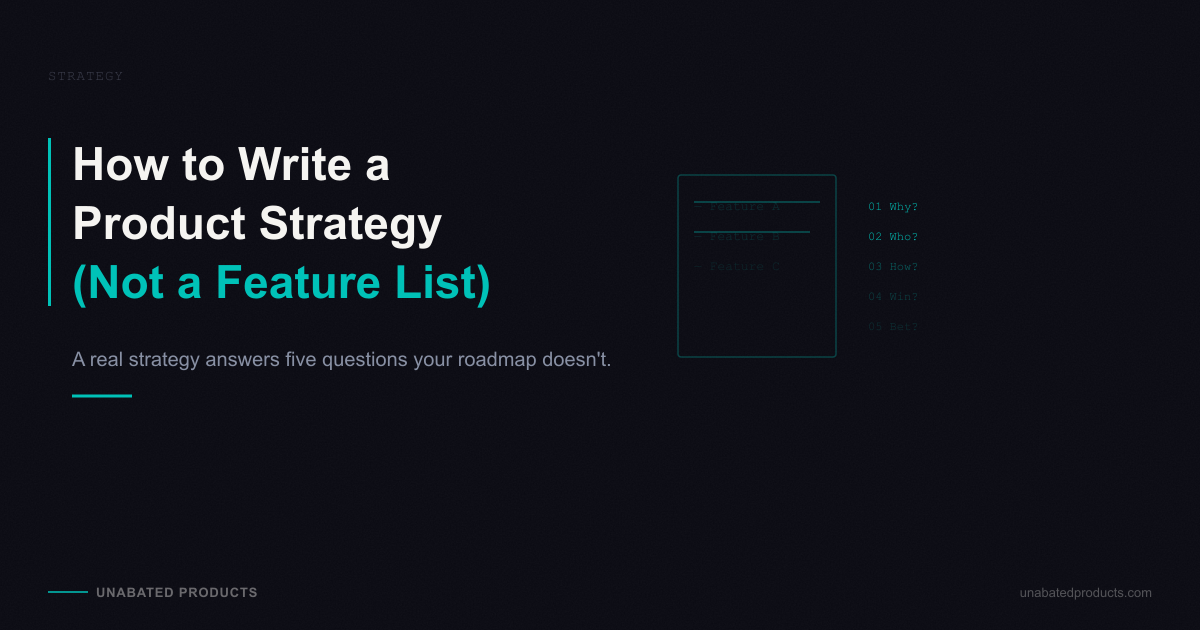
In the vision and strategy lesson of The Influential PM, I put three versions of a strategy on the screen. The first one says that in year one we build a mobile app and add integrations, in year two we add AI, and in year three we go international. It is the kind of strategy a good product manager would present. It is also a set of features with years attached, which tells an engineer what to build and nothing about how to decide.
A product strategy is the set of major milestones that get you to your vision, in the order that lets you win along the way. So a useful product strategy template has to make you write down where customers are hurting today, where you are taking them, and what comes FIRST. The one I teach fits on one slide.
My test is whether your team can make a good decision with that slide when you are not around (out talking to customers, ideally). A strategy should work as a rubric for decision-making, the same way a teacher's grading sheet lets a student check the essay before handing it in. A list of features fails that test the first time somebody finds a case the list did not cover. Then the question comes back to you.
The product strategy template
The whole slide is the lines below, and you fill in the brackets for your own product.
Today, [one customer you can name] has to [the current painful situation]. It costs them [time, money, or both].
Our vision is a world where [customer] can [outcome] without [the current friction].
Year one, we start with [which customers first] and [which problem first]. We have evidence the problem is pervasive and urgent: [your evidence]. We will be dramatically better than [what they use today] because of [our unique advantage]. Before that, we have to build [which capabilities first]. We will know it worked when [the customer's success metric], which is worth [amount] to our company.
Year two, we expand to [the next customers or the next problem]. That gets easier because year one gave us [the advantage we gained].
Year three, we scale to [where the vision is true for most of those customers].
Not yet: [what we are postponing on purpose, and the milestone it waits for].
The years are a convenience. Milestone one, two, and three works just as well. With AI moving the way it is, I would not peg a calendar date on the later ones.
Start with the top line, because it is the one people skip. If you cannot name one person who has the problem, then you are making up the customer truth. I have done it. I once had a legal tech startup that ran on another person's intuition about what customers wanted, I could not name any of those customers myself, and it failed.
The vision line is a sentence about the customer, so it should not name your solution. It also draws the boundary. The vision is what says no, because it marks the area you operate in, and the strategy says not yet, because it is the order of operations for getting there.
Most of your thinking goes into year one. You are looking for a problem that is pervasive (if you interviewed ten people and heard it once, it is not) and urgent enough that customers are trying to solve it right now and would pay to. Then you need a way to be dramatically better than what they already use, built on an advantage that competitors will struggle to follow. Matching a competitor does not count. People who already have a solution have no reason to switch to an equal one.
The capabilities bracket is for prerequisites, the things you have to build for yourself before you can solve the customer's problem well. (At HealthMine, the digital health company where I had several product teams, that bracket said integrate the health data. The analysis that identified who needed help could not run without it.) The last bracket in year one has two sides on purpose. Every milestone needs a number for what changes for the customer and a number for what that is worth to us, because this is a business and we still have to make money.
When I have more ideas for a milestone than the slide can hold, I run them through the DHM filter, which comes from Gibson Biddle and Netflix. It asks whether an idea will delight customers enough that they tell others, whether it is hard to copy, and whether it is margin-enhancing. Only a couple of ideas get through all three. It is one of the product strategy frameworks I teach for choosing what goes first.
A product strategy example, filled in
The example I teach with is an illustration. It is not a company I built, and nobody has solved this problem in the market yet.
The second version on the screen is better than the feature list. It has a vision (healthcare happens when patients need it) and three stages: start with urgent care, move into primary care, then become a platform that other providers use for any type of care. But it still does not say how we would measure success, what the proof is, or why we would win.
The third version fills in every line. Today, Sarah cuts her hand at 11 p.m. Her doctor's office is closed, and urgent care is either closed or booked. So she waits four hours in an emergency room behind more serious cases and goes home with a $2,000 bill. The vision is a world where people can get healthcare when they need it, not when they can find an appointment.
Year one, we start with people who have an urgent but not serious problem at an hour when nothing else is open. We will know it worked when someone like Sarah gets care in under an hour for $150. Say we own hospitals. Then our advantage is the physicians, facilities, and technology we already have. Year two, we expand into primary care, which gets easier because proving it in urgent care gives us an advantage that compounds. Year three, we scale to a platform for any type of care, and that could reach millions of people a year. Primary care and the platform are the not yet, and they wait until that urgent care number is real. (A real version would carry our side of the number too. That means what we earn on a $150 visit and how many of those visits there are in a year.)
Look at what the slide leaves out. It never says scheduling platform, text messaging, or telehealth. Those are possible solutions, and you should have one in mind, but the strategy has to decide first that this problem is worth solving for these people.
Only year one needs detail. Your roadmap is a more detailed view of year one, broken into quarters, and each quarter is a bet on something that moves the year-one number. It also makes your ask of an executive smaller. They do not have to believe in all three years, only to let you prove the first one.
The line your team uses when you are out
The not-yet line does the most work after the slide is approved. When a stakeholder asks you to add something to the roadmap, they can already see that it comes later and which milestone it waits for, so the answer they get is "not yet" instead of "no."
Your team uses it too. Say an engineer has to choose between a need from this year's customer and a need from a different persona. If they know that persona arrives in year two, they will build for this year's customer and leave room for the second, and you do not have to be there. If they do not know where you are going, then you have to make every choice explicit in every user story. Most product managers I see cannot get out of that spot. They are in the stand-up every morning and answering comments in Jira all afternoon, because the team has learned to say "okay, you tell me." It is how a capable product manager ends up running a feature factory without ever choosing to.
What to do this week
Fill in the template for the product you work on now. Your first vision line will probably be boring. That is fine. Write three to five of them, push one to the edge of crazy, and keep the one that lands in between.
Then look at the brackets you could not fill. Each one is a question for whoever handed you the roadmap: which customers first, which problem first, which capabilities first, and what are we saying not yet to? If you were given a strategy, somebody should already have those answers. If nobody does, you have found the reason every decision lands on your desk. One slide your team can decide with is how you get out of the stand-up and back in front of customers.
-Brennan
◆
The Influential PM is my three-week live cohort on Maven, and you build this one-slide strategy for your own product in it. See the course details.
The Influential PM is a 3-week live cohort for B2B PMs who want to operate at the strategic level. Get the career results that follow.
Former VP of Product at a Big 4 firm. Has coached 500+ PMs across Fortune 500 companies. Teaches the Influential PM cohort on Maven.