B2B2C: What It Means and How to Build a Product Strategy
B2B2C means you sell to a business that puts your product in front of its own consumers. A real example, and how to build strategy for both.
I have lost a sales deal to Oprah and Dr. Oz. It happened more than once. I was leading product at a digital health startup that sold to health insurance companies, and we kept coming in second place to two television personalities. The reason we lost is one of the most useful things I learned about building a B2B2C product, but it only makes sense once you see how the product worked.
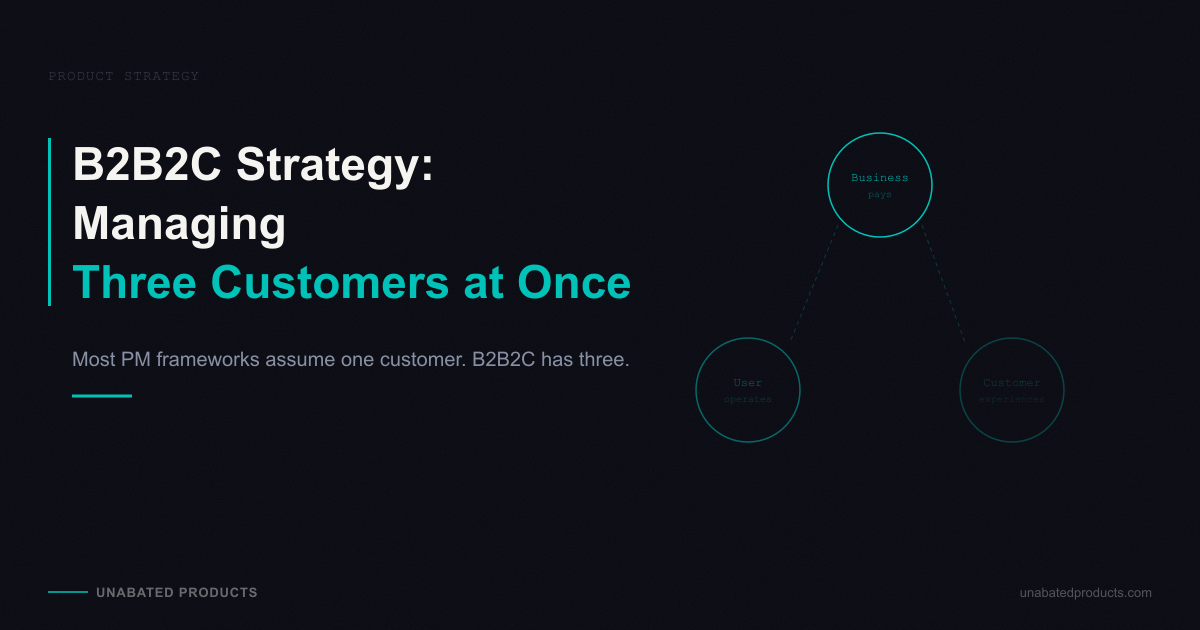
B2B2C (business-to-business-to-consumer) is a business model where you sell your product to another business, and that business puts it in front of its own consumers. One company signs the contract and pays you, and a different set of people open the thing you built. For us, the buyer was a health insurance company and the users were its members, meaning everybody who carries that company's insurance card.
That sounds simple until you sit down to write a roadmap for it. The buyer and the user want different things from you, and you don't get paid unless both of them get what they came for.
A B2B2C example from health insurance
The company was called HealthMine. We sold health insurance companies a product that analyzed the health data of all their members. It figured out who had the most critical needs, and those were mostly people with chronic conditions like diabetes and heart disease, since chronic conditions are the primary cost drivers for an insurance company. Then we gave those members web and mobile apps to educate and motivate them to take care of themselves.
So we had two customers to understand, and we researched them separately. My design team interviewed dozens of consumers about their everyday health and how hard a doctor's visit is for them. I did the research on the business side, with the clinical teams inside the insurance companies. Their job was to collect data on every member, find the people at highest risk, and get those people to act. Sit in their chair. You have a million members and five nurses, so who do you go after first?
We drew two maps. One followed a member trying to get to the doctor. The other followed the clinical team from collecting the data to measuring whether anyone's behavior changed.
B2B2C gets harder than selling to one customer at exactly this point, because those two personas were potentially at odds with each other. Most people distrust their health insurance company. They don't trust it for advice, for help, or for much of anything else. When we held the two maps side by side, we found four needs where a member would let a health insurance company help. We built around those four and left the rest alone.
The one action both customers need
We needed the place where the two maps touched. We found it in a measure the insurance industry already used, called a gap in care. It means care a member should have gotten and has not, like an overdue doctor's visit or an unfilled prescription.
Say a member has diabetes and heart issues, has not been to the doctor in three years, and has not filled a prescription in 90 days. It was worth it to the health insurance company to send that person a reward: go to the doctor and you get $100. If that person ends up in the hospital instead, the insurance company foots the bill. That bill is going to be a great deal more than $100.
That one example is the whole business. The insurance company paying us wants that doctor's visit to happen, because a prevented hospital stay is money it never spends. The member wants better health at a lower cost, and to get there the member has to make that same visit. The two of them would never describe the goal in the same words, but they are after the same thing.
In a B2B2C product, the roadmap is built around the one action the end user will take for their own reasons and the buyer will pay to see happen. For us that action was closing a gap in care, so it became our measurement of success. The roadmap came straight off the member's map. Every step we couldn't support yet got outlined in red (we had nothing to help a member book an appointment, for example), and the red boxes were what we built next.
I could have gotten this wrong in either direction. If I had pushed everything the business wanted onto the consumer, members would not have trusted it or cared, because all of it served the insurance company. If I had built everything from the consumer's side, people would have learned about their health and then done nothing, and the insurance company was not going to pay me for that. I had to satisfy both sets of needs at the same time, which was really difficult, but we did it. I kept the two sides connected by working the strategy backwards from who was paying us:
- A health insurance company pays us when we can measure the impact.
- The impact is cost savings, because preventing a catastrophic event in somebody's health saves the insurance company a lot of cost.
- The savings only show up when members act on their health. They take their medication, and they see the doctor before something goes wrong.
- Members only act when we can reach them, give them guidance that fits their situation, and motivate them to follow it.
Read from the bottom up, that list is a ladder from a feature in a consumer app to the insurance company's money, and then to ours. In the course I teach it as the User-Buyer Bridge. You connect the user's job to the buyer's economics so the buyer is never left guessing at the value. Then you keep going until you reach how your own company gets paid, which is what I mean by thinking like the business owner. Most product managers stop at the user level.
How I lost to Oprah anyway
We thought we had a great product, and we could see it working with consumers too. We still lost multiple deals, because of a fallacy in my understanding of our users and our buyers.
I was pitching features and I was pitching user results, because I thought those were what mattered. Oprah and Dr. Oz pitched that they would help the insurance company sell more insurance. My first reaction was confusion. We are in the digital health and wellness business, so how does this relate to selling insurance? But Oprah said she would host events if they bought, and for that buyer the product itself hardly meant anything. The return they wanted was revenue and sales, and I had walked in talking about what our users got.
What's funny is that I had already learned this lesson once, selling software to hospitals at the company before. Then I went to the startup, forgot it, and had to learn it again in a different way. (Learning it twice is why I teach it now.) We came in second multiple times, and those losses led to a strategy pivot.
The buyer in a B2B2C deal is paying for a result in their own business, and the end user's outcome only counts once you can show how it produces that result. You find out what that result is by asking how the buyer makes money and how they are measured. That is a big part of why I push product managers to get comfortable with the financial side of their customers. The people who sign the contract often don't know the pain points of their own staff, so you can't pitch them those pain points and expect it to land. Speak at the level of their economics, and then show them how the user's side connects to it.
What to do this week
Pick the feature at the top of your roadmap and write its chain on one page. Start with what the end user does differently because of it. Then write the result that produces for the business paying you, in their money, and what that earns your company. Do not stop at "users will work faster" or a vague promise like "it helps people save money." Both leave the buyer to do the mental math, if they do it at all.
Then mark every link where you are guessing, and go ask. If you can't get to the buyer directly, ask the users you can reach. What are your objectives this year? How are you evaluated? What are your clients trying to achieve with your service? Their answers tell you what the buyer is shopping for, and one conversation this week is a lot cheaper than coming in second to Oprah to find out.
-Brennan
◆
Want to build the bridge between YOUR users and YOUR buyers with a coach working through it with you? Join The Influential PM, my three-week live cohort on Maven.
The Influential PM is a 3-week live cohort for B2B PMs who want to operate at the strategic level. Get the career results that follow.
Former VP of Product at a Big 4 firm. Has coached 500+ PMs across Fortune 500 companies. Teaches the Influential PM cohort on Maven.