Section 127 Educational Assistance: Get Your Employer to Pay for PM Training
Section 127 educational assistance can cover $5,250 of PM training tax-free. How to find your company's plan, the email to send, and what to do if they say no.
This is general information, not tax or legal advice. Consult your tax advisor, or your employer's HR and legal teams, for guidance specific to your situation.
◆
A product manager sat on the same enrollment page for three weeks. (This is a composite scenario drawn from patterns common among the adult learners I coach.) She wanted in. She had read every page, watched the testimonials, and run the math on whether her paycheck could absorb the cost. The math did not work.
She was about to close the tab when a colleague mentioned that their company had something called an educational assistance program, which she had never heard of. So she sent one email to her L&D team. Two weeks later, her employer covered the full cost.
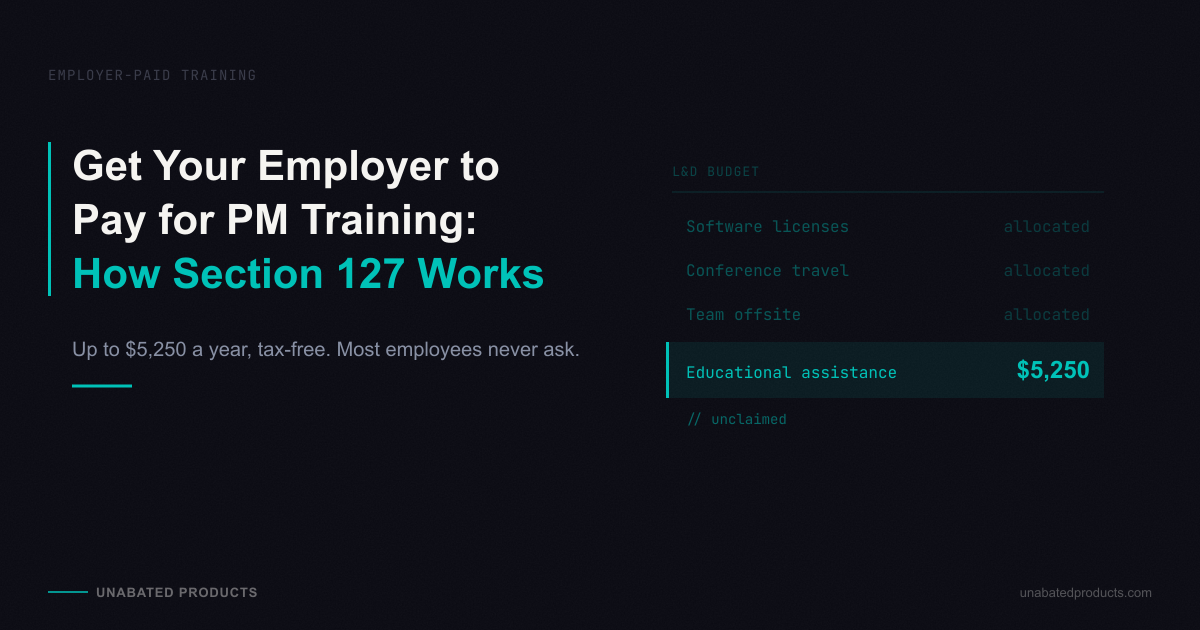
Most product managers treat professional development as a personal expense, like a gym membership. But one section of the US tax code lets your employer pay up to $5,250 a year of your education costs. Tax-free to you, deductible to them. If your company has a written plan, the money is already budgeted. Most employees never ask for it.
This piece explains how the benefit works, who to ask, and exactly what to say.
◆
The two provisions that matter
Two sections of the US tax code can pay for your PM training. They work differently, and they are not mutually exclusive.
IRC §127: educational assistance programs
Section 127 keeps up to $5,250 per year of education costs out of your gross income. No tax for you. A deductible business expense for them. The statute is blunt about the ceiling. If the benefit would exclude more than $5,250 in a calendar year, "this section shall apply only to the first $5,250 of such assistance so furnished" (26 U.S.C. §127(a)(2)).
Two things changed recently, both in your favor. The One Big Beautiful Bill Act (Pub. L. 119-21, signed July 4, 2025) made employer payments toward qualified student loans a permanent part of §127 (IRS Publication 15-B, 2026). Before that, the provision was set to expire at the end of 2025. The same law added a new §127(d), which indexes the $5,250 cap to inflation for taxable years beginning after 2026. For 2026 the number is still a flat $5,250. Starting in 2027 it moves, rounded to the nearest $50 (26 U.S.C. §127(d)).
The catch is that your employer must have a formal written plan. The plan cannot favor highly compensated employees. And no more than 5% of the annual benefit can go to shareholders or owners holding more than 5% of the business.
What §127 does not require is that the education be job-related. That is the part most people miss. Your employer can cover a course with no connection to your current role, as long as it counts as education rather than recreation. The IRS lists tuition, fees, books, equipment, and supplies as covered. Meals, lodging, transportation, and supplies you keep afterward are out (IRS Tax Tip 2025-59).
IRC §132(d): working condition fringe benefits
Section 132(d) covers a broader category. It reaches any property or service you could have deducted as an ordinary and necessary business expense if you had paid for it yourself. No dollar cap applies. In exchange, the test is harder: the training has to be clearly job-related. The operative language is that the education "maintains or improves skills required by the individual in his employment" (Treas. Reg. §1.162-5).
What that looks like for a product manager, from easiest to hardest to defend:
- A working B2B PM taking a product strategy or stakeholder-influence course. Clears the bar.
- A senior PM taking an executive communication or P&L translation course. Defensible.
- A PM taking a coding bootcamp when they do not write code in their role. Harder.
- An MBA for a PM whose path does not lead to general management. Hardest.
These four are my read of the §1.162-5 standard as a practitioner, not an IRS ruling. Your company's legal team makes the call.
There is also an overflow route most people miss. IRS Publication 15-B says that assistance above the $5,250 cap must be reported as wages unless the benefits qualify as working condition benefits. So a $7,500 course can run $5,250 through §127. The remaining $2,250 can run through §132(d), if that remainder passes the job-related test on its own. Same employee, same course, two sleeves of the same benefit.
| | §127 | §132(d) | |---|---|---| | Annual dollar cap | $5,250 (indexed from 2027) | No cap | | Job-related test | Not required | Required | | Written employer plan | Required | Not required | | Tax-free to employee | Yes | Yes | | Employer deductible | Yes | Yes | | Covers student loan repayment | Yes, permanent as of 2026 | Depends on job-relatedness |
For most mid-career PMs in B2B product roles, PM training qualifies under either provision. The practical difference: §132(d) can cover more than $5,250. But it only works if your legal or HR team will make the business expense determination. Most employers default to §127, because the written-plan structure makes compliance easy.
◆
What "having a plan" actually means
A §127 plan is a document. It is a written employer policy that defines who is eligible, what expenses are covered, the dollar limit, and how to request assistance.
I do not have reliable data on what share of companies maintain one, so I will not guess at a number. What I can tell you is the pattern I see in coaching sessions. PMs who assume their company has no plan are frequently wrong. The ones who turn out to be right found out by asking, not by assuming. If your company has a formal L&D function, a written policy almost certainly exists somewhere. Early-stage startups with no HR function usually have nothing. Those PMs should look at §132(d) or a manager's discretionary budget instead.
How to find the plan document. Check three places before you email anyone.
- The benefits portal (Workday, ADP, Rippling, Gusto). Search "education," "tuition," or "learning."
- The employee handbook, under benefits or professional development.
- The intranet or HR knowledge base. Search "127" or "tuition reimbursement."
If nothing turns up, ask HR directly. Plan documents are not confidential, and employees are entitled to see the written plan that governs their benefits. A short request works: "Could you share the educational assistance plan document, or confirm whether one exists?"
When you get the plan, check five things: the annual dollar limit, eligible course types, the application process, clawback terms, and the fiscal year cycle. The cycle matters most. If the L&D budget resets in October, asking in November is a very different conversation from asking in August.
◆
Who to ask, in what order
1. L&D or Learning and Development. The right first call. They own the plan, know the budget cycle, and can tell you what the process looks like.
2. HR or Total Rewards. HR administers the written plan. Go here if L&D routes you over, or if there is no dedicated L&D function.
3. Your direct manager. Many managers hold a discretionary development budget outside the formal plan. Even with a waiting period or a budget freeze, your manager may be able to approve training directly. Frame it as a team investment, not a personal ask.
4. People Ops, at startups. Where HR and L&D are combined, whoever runs People Ops knows the budget. That holds even if the answer is that no formal plan exists yet.
◆
The email that works
This is the most useful thing in this post. Copy it, adjust the details, and send it.
Subject: Educational assistance for product management training
Hi [L&D contact or HR/Total Rewards],
I am looking into a product management training program, a live coaching cohort covering product strategy, stakeholder influence, and business outcome communication. It runs three weeks and costs $1,295.
I wanted to check whether this would qualify under our Section 127 educational assistance plan, and what the process looks like for requesting it.
Happy to provide a course description, syllabus, or completion attestation if you need one. Let me know what documentation works best on your end.
[Your name]
Three things this email does. It names the benefit by section, which signals you have done the reading. It offers documentation up front, so HR does not have to chase you. And it frames the course as professional education rather than personal development, which is the distinction that governs the plan determination.
◆
What happens after you ask
Approval typically takes one to four weeks, depending on how formal the process is. That timing is my observation from coaching sessions, not an IRS rule, so treat it as a planning estimate rather than a promise.
You may be asked for a course description or syllabus. Most training providers can supply one. A PM cohort covering product strategy, metrics, stakeholder communication, and business model translation is almost certain to clear the "education" threshold.
Some companies require a completion attestation before they reimburse. Some require a clawback agreement, where you repay part of the benefit if you leave within 12 months. Both are ordinary employer practice rather than tax requirements. Neither is a reason not to ask.
If you are aiming at a specific cohort start date, send the email three to four weeks before enrollment closes.
◆
What to do if they say no
Three paths still work.
1. The next budget cycle. L&D budgets reset annually. If this year's allocation is spent, ask to be noted for the next cycle and put the conversation on your manager's calendar 90 days before the reset.
2. Your manager's discretionary budget. The ask is different here. You are asking them to invest in your skill development, not to open a benefits program. Talk about what changes in your work next quarter if you have the training. "If I take this, here is how our planning conversation goes differently by Q4" lands better than a credential.
3. Reimbursement after completion. Some companies have no written §127 plan but will pay for training as an expense once you finish. That is informal §132(d) treatment. The tax handling is messier, and reimbursements can be taxable income if not structured correctly, but it is often available when the formal plan is not.
◆
What this gets you
Good PM programs are not cheap, because coaching does not scale. In a small live cohort you bring your actual product, your real stakeholders, and your specific roadmap fights. A 300-person recorded course cannot do that. The coaching is the product.
If cost has been the reason you have not committed, go ask. The downside of asking is a no. The downside of not asking is that you keep funding it yourself, or you skip the training.
The Influential PM enrollment page is at maven.com/unabated-products/the-influential-pm. It runs three weeks with nine live sessions. The cohort on the calendar is November 3 to 18, 2026 (enrollment closes November 2, 2026 at 9:30 PM Central).
If cost is the only thing in the way, the email earlier in this post is the entire ask. Copy it, put your own numbers in the business case line, and send it to your manager and your L&D team.
◆
Disclosure: Unabated Products is not a tax advisor. This post is general in nature and reflects publicly available IRS guidance and statutory text as of August 2026. Your employer's plan terms, eligibility rules, and approval process govern what is available to you. Consult your company's HR, L&D, or legal team, and a tax professional if needed, before acting on any of the above.
The Influential PM is a 3-week live cohort for B2B PMs who want to operate at the strategic level. Get the career results that follow.
Former VP of Product at a Big 4 firm. Has coached 500+ PMs across Fortune 500 companies. Teaches the Influential PM cohort on Maven.