How to Niche Down as a Product Manager (And Why Generalists Lose)
200 applications. Zero interviews. Most PMs position themselves as "B2B SaaS Product Manager" and compete with 50,000 others. The ones who get hired niche down until they're the only candidate who fits.
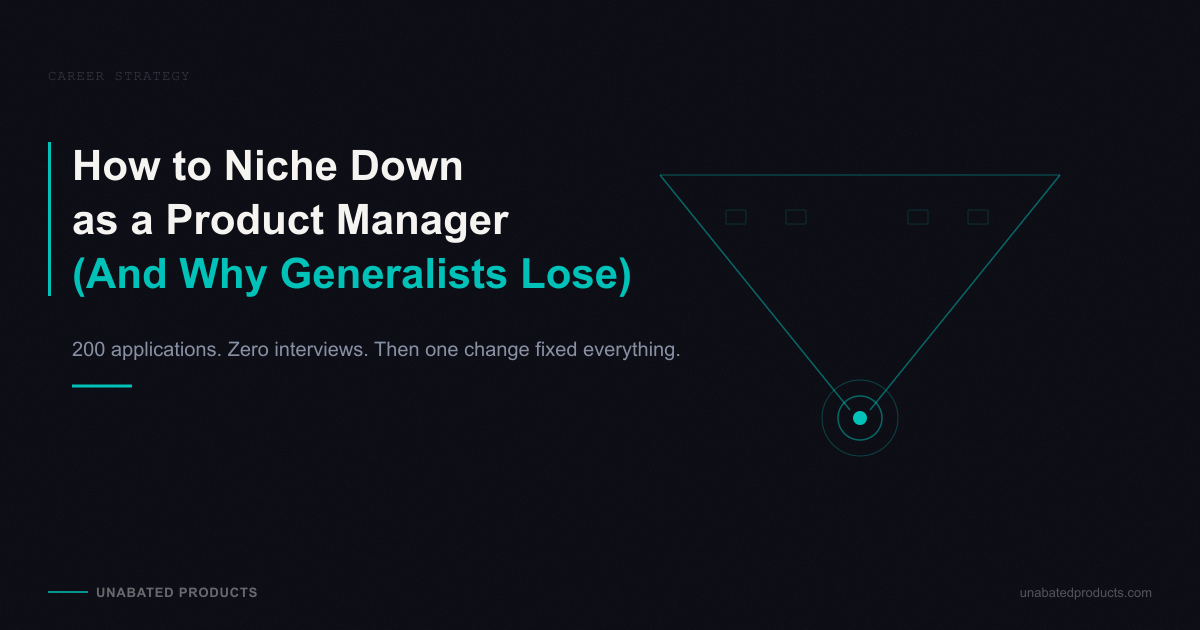
A PM I coached sent 200 applications. All of them said "B2B SaaS Product Manager."
Zero interviews.
He had real experience. A drone technology company that processed 20 million aerial images. $15 million in funding. $3-4 million ARR. He'd helped scale a geospatial SaaS platform from a 4-person team to 15 engineers.
But his positioning was identical to every other resume in the pile. And that was the problem.
The generalist trap
B2B SaaS isn't a niche. It's a category containing roughly 50,000 product managers. When you apply as a "B2B SaaS PM," you are competing with all of them. And your resume is probably 80% similar to theirs.
Geospatial SaaS, built on drone data, with experience scaling from 4 engineers to 15? That is a niche. There might be 30 companies hiring in that space at any given time. And maybe 2 other candidates who actually fit.
This isn't a career strategy insight. It's a product strategy insight applied to your own career.
If your product served every B2B company equally, you would never describe it that way in a pitch. You would pick the customer segment with the sharpest pain and build your messaging around their specific problem. You would narrow until you were the obvious choice for a small group instead of a decent option for everyone.
Your career works the same way.
How to find your niche
Most PMs resist niching down because they think it limits their options. It's the opposite. Broad positioning means you compete on quality. Narrow positioning means you compete on fit. Quality is subjective and hard to prove in a resume scan. Fit is obvious and immediate.
Your niche sits at the intersection of three dimensions.
Domain. What industry or problem space do you know deeply? Not "B2B" or "enterprise." Something specific. Healthcare data interoperability. Fintech lending workflows. Developer tooling for infrastructure teams. Supply chain visibility for manufacturing. The more specific, the fewer competitors.
Skill. What type of product work are you strongest at? Growth and monetization? Platform architecture? 0-to-1 product creation? Multi-sided marketplace balancing? Data products? This narrows which roles actually fit your strengths instead of which titles sound good.
Stage. What company maturity matches your experience? Early-stage companies need PMs who can talk to customers and ship without process. Growth-stage needs PMs who can scale what works. Enterprise needs PMs who can navigate organizational complexity and long sales cycles. A PM who thrived at a 10-person startup and a PM who thrived at Salesforce have different superpowers. Neither is better. They are different.
When you combine all three, you get positioning that is extremely hard to compete with. "Growth PM for multi-sided marketplaces in the fintech space, at Series B to C companies." That description matches a small number of companies. And when one of those companies is hiring, you are the obvious candidate.
The VC portfolio mining technique
Once you know your niche, the next problem is finding companies before they post the job.
Here is a technique I taught two PMs who were stuck in the cold-application cycle.
Go to the VC firms that fund companies in your niche. Every major VC publishes their portfolio on their website. Look at their recent investments, specifically companies that closed a round in the last 3 to 6 months. Those companies have fresh capital and mandates to grow. They are hiring. Many of them have not posted the role yet because they are still figuring out their org chart.
Find 15 to 20 of these companies. Look at who works there on LinkedIn. Start with product leaders, then broaden to engineering and design. Your goal isn't to apply. Your goal is to build a relationship with someone inside before the role gets posted.
One PM I coached shifted from mass-applying to this targeted approach. Within weeks, he went from zero responses to active conversations with companies where his background was the answer to their specific problem.
The 5-day relationship funnel
Cold applications are a volume game with terrible conversion rates. The relational approach converts better because you are building signal before the hiring manager ever sees your resume.
A PM applying to the New York Times had a strong resume. 7+ years of experience. Data platform specialization. Products generating real users. He applied, waited, followed up. Nothing.
We changed the approach entirely.
Day 1: Find someone at the target company who posts on LinkedIn. Not necessarily the hiring manager. Anyone in product, engineering, or the broader org. Leave a comment on their post. Skip the generic "Great insight" praise. Say something specific that shows you have been thinking about the same problems they are working on.
Day 3: Send a short DM. Reference their post. Something like: "Your post about [topic] got me thinking about this problem differently. I have been following what [company] is doing in this space."
Day 5 to 7: Ask for a 15-minute conversation. Not a referral. A conversation. "I'd love to hear your perspective on [specific thing] for 15 minutes. No ask beyond that."
What happens is predictable. The person remembers your name because you showed up as a thinker, not a job seeker. In the 15-minute call, you learn things about the company that no job description will tell you. If the conversation goes well, they ask what you are looking for. The referral happens without you requesting it.
Do this with 15 to 20 people at a target company. 5 will engage. 2 or 3 will take the call. 1 will pass your resume to the hiring manager with context about who you are and why you fit.
That single warm introduction is worth more than 200 cold applications.
The math that makes this work
Cold applications convert at roughly 2 to 5%. That means 200 applications gets you 4 to 10 interviews, most of which are mismatched because you applied broadly.
The niche-and-network approach works on different math. You are targeting 15 to 20 companies where your background specifically fits. You are building relationships with people inside those companies. Your conversion rate from introduction to interview jumps because the fit is obvious from the start.
Fewer companies. Higher fit. Warmer introductions. Better interviews. The PM who niches down and networks with intention will beat the PM who applies broadly and hopes for the best. Every time.
The positioning test
If you described your PM niche to someone outside the industry, would they know exactly which companies need you? Or would it sound like you could work anywhere?
"I'm a B2B SaaS product manager" tells nobody anything.
"I build growth systems for multi-sided marketplaces in fintech, usually at companies between Series B and Series C" tells a very specific set of companies exactly why they should talk to you.
If your positioning doesn't pass this test, you haven't niched down far enough.
The PMs who get hired fastest aren't the ones with the best resumes. They are the ones who make the hiring manager think: this person was built for this exact role. And that only happens when you stop trying to be qualified for everything and start being undeniable for something specific.
The Influential PM is a 3-week live cohort for B2B PMs who want to operate at the strategic level. Get the career results that follow.
Former VP of Product at a Big 4 firm. Has coached 500+ PMs across Fortune 500 companies. Teaches the Influential PM cohort on Maven.