Influence Without Authority: The Meeting Before the Meeting
Influence without authority is earned before the meeting starts. How product managers use one-on-one conversations to win over people they do not manage.
In 2017 it took me about three weeks to figure out a new strategy for my digital health company, and at least six months to get people to follow it. Most of the people who had to act on it did not report to me. That is the situation people mean when they talk about influence without authority.
For a product manager, influence without authority means getting people you do not manage (engineers, salespeople, executives) to commit their time, their budget, or their vote to your idea. You earn that commitment one person at a time, before the meeting where you ask for it.
I learned this the expensive way. We had just lost a $10 million deal and then an $8 million deal to the same competitor, finishing second both times. Our venture funding was contingent on those wins, so I went from hiring to laying off three-quarters of my team. It hurt. I still think about the people who had put their trust in me.
Reworking the strategy took three weeks of dedicated work. That was the easy part. Then I had to convince the CTO that we would not have to rewrite the entire product. I had to convince sales and marketing to leave a market where we kept coming in a close second. My boss, the CEO, did not want to take any option off the table, and the board had just watched us flop. After them came 75 shaken employees who had just seen their friends get laid off.
Influence without authority is the second job
Product managers really have two jobs. The first is figuring out what to build: the market research, the strategy, and the metrics you will hold yourself to. The second is getting everyone to believe you, and I would argue it is the harder one.
For years I did the second job badly. I would do the work, bring all of the logic to the meeting, and assume that everybody would see it. But those meetings were rarely about the decision. A decision meeting is a stage, and some of the people in it are performing so that they look bigger and their careers grow. I had never asked for their expertise ahead of time, so the only place left for their input was in front of everyone else.
What each of those people is protecting is its own subject, and I wrote about it in the hidden incentive system.
The meeting before the meeting
I had heard the phrase "the meeting before the meeting" for years and never did it, because I assumed good logic would be enough. It ended up being one of the most useful things I do when I need a decision from people I have no power over.
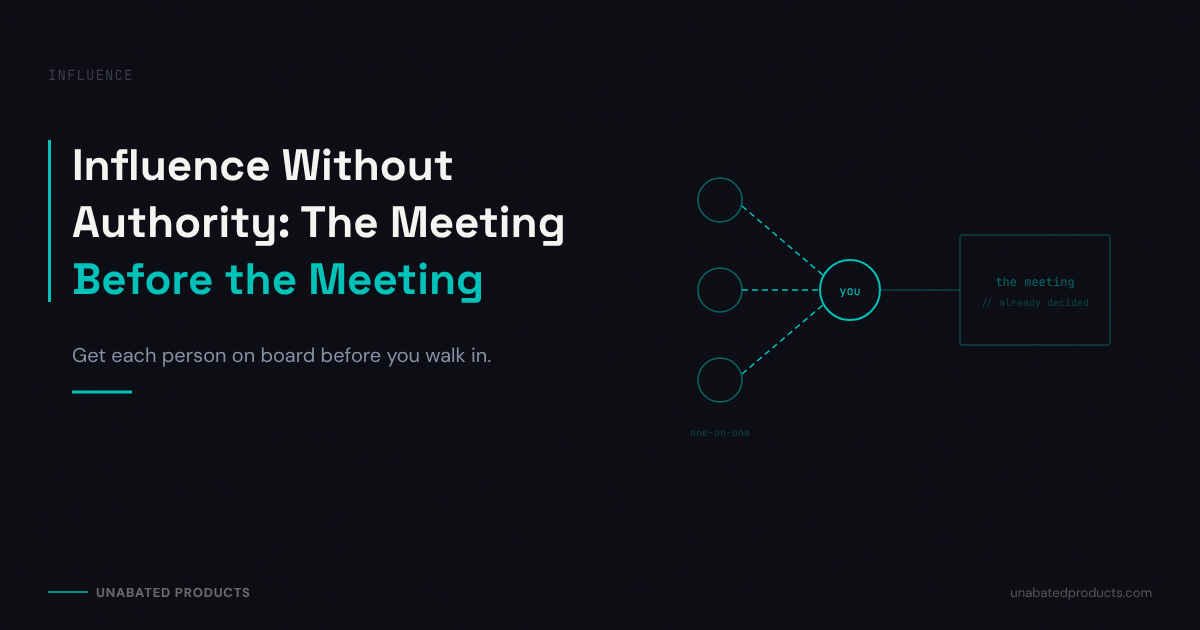
The meeting before the meeting is a one-on-one conversation, held about a week ahead, where you ask each person for their concerns and their advice so that nobody has to raise them for the first time in front of an audience. You have one with every person who could veto the idea or take over the conversation.
Open with something close to "I want to get your perspective before we go into this meeting," and ask for their concerns and their advice. Then let them talk. The objections they would have performed for the group come out with no group watching, and you hear them while there is still time to change your proposal. These are the questions to bring:
- If this is the best information we are going to get, what would you decide? (Tell them the answer is unofficial.)
- What is the worst thing that happens if we commit to six months and we are off by a little?
- What does success look like for us this next year?
DO NOT let the one-on-one turn into a status update. If they spend the time interrogating you about what information you have, you will leave knowing nothing about what worries them, so ask open-ended questions and listen.
Then, in the meeting, make their point for them and use their name. "[Name] had a great point when we talked about this earlier" is all it takes. That person no longer needs to make the point, because you have vouched for their perspective in front of everybody and shown that you valued it enough to remember it. (I will admit that part of the goal is to keep them from talking for 45 minutes when 5 would do.) They still get the credit.
Do that with each person and they are already on board before you walk in. The showmanship is gone, and the group can talk about the actual issue.
Two years of meetings that never decided
Two product managers who report up through a stack of engineering leaders came to my office hours together. By then they had run a structured prioritization meeting every quarter for about two years. They would bring a proposed plan that tied back to business metrics and their key markets. The leaders would ask for more information, and then more after that. The meeting would often end on "let's follow up on this in a few weeks," but other priorities came up before anyone did. Nothing got decided. Later, engineering would pick about a month of work to keep the team from sitting idle, without the two of them.
I told them they were dealing with psychology now, and that more research was never going to help, because those leaders already had plenty of information. Decisions were scary for them. The team had recently put a ton of work into something a client decided not to use. That made every question about a missing number or the wrong format a wall, with something behind it they did not want to talk about yet.
So I recommended the meeting before the meeting. About a week ahead of the next prioritization session, each of them would sit down one-on-one with each of the two leaders. They would frame it as asking for advice on what the group was going to have to decide. First they would exhaust every question the leader had. Then they would ask what the leader would decide with the information on hand, unofficially, and what could go wrong with a six-month commitment.
Those questions let a nervous person think out loud without a stage. I told them they had to earn the right to have the conversation behind the wall, and a status report was never going to earn it.
The line between influence and playing people
Most people hate politics, and I do too. But there is a game happening in every company whether I want it there or not. If you cannot see it, you are a piece on somebody else's board.
The meeting before the meeting only works when everything you say in it is true. You ask for their concerns because you want to shape the idea with their expertise. You credit their point in the meeting because they made it. When you describe the same idea to each person in terms of the number they are measured on, it has to be a better description of the same thing. If it is not accurate, it is spin. And when your idea does nothing for the person across the table, tell them so, and ask whether they will support it for the customer's sake.
I think about authority the same way. Real authority can come from having no real power and treating the outcome as yours anyway, as a steward of the company and not out of ego. My goal with a sales team was that they win. When they collect their bonuses and commissions, the company is making money, and we all win. That is why I have had sales executives ask whether they could report to me instead of to the Chief Revenue Officer.
What to do this week
Find the next meeting where you need a decision from people who do not report to you. Write down everyone who could veto the idea or take over the conversation, and get time with each of them one-on-one before it happens. Ask for their concerns and their advice, and listen more than you talk. Then open the meeting by naming what you heard and who you heard it from.
It will feel slow the first time, and you will probably be tempted to skip it because your logic is good. Do it anyway. (I still have to remind myself to do it.)
This is the proactive half of influence. The responsive half is what to say when a stakeholder walks up with a demand you did not ask for. I call that Stakeholder Judo, and those conversations are on the stakeholder management page. What to say in front of executives is in how to talk to executives as a product manager.
A product manager with a good strategy and nobody following it has done one of the two jobs, and it took me six months in 2017 to learn that it was the easier one.
-Brennan
◆
Want live practice at getting people who do not report to you behind your strategy? Join the next cohort of The Influential PM.
The Influential PM is a 3-week live cohort for B2B PMs who want to operate at the strategic level. Get the career results that follow.
Former VP of Product at a Big 4 firm. Has coached 500+ PMs across Fortune 500 companies. Teaches the Influential PM cohort on Maven.